

At low-to-moderate doses, THC commonly produces short-term mood changes that lean positive: relaxation, mild euphoria, and reduced negative affect. A 2026 Frontiers in Pharmacology review confirms that THC modulates the endocannabinoid system and downstream neurotransmitter pathways in ways that directly influence emotional state. A prospective IV-THC trial published in BMC Psychiatry found that peak subjective effects occur within about an hour after administration. Higher doses shift that picture, often producing anxiety, paranoia, or confusion instead. For adults using THC beverages, the practical takeaway is simple:
- Start with a low-mg serving (2–5 mg THC)
- Wait at least 60 minutes before considering more
- Choose a product with a clear CBD:THC ratio and transparent labeling
- Avoid driving or mixing with alcohol during the effect window
Table of Contents
- How THC regulates mood in the brain
- Why your mood response to THC may differ from someone else’s
- How dose, formulation, and CBD balance change your experience
- Short-term mood benefits and risks you should know about
- What the evidence says about long-term mood and depression risk
- A safety checklist for using THC beverages responsibly
- When to stop and when to get medical help
- How strong is the evidence, really?
- Key Takeaways
- A note on what I watch for with THC beverages
- Tryfloral’s farm-to-fridge THC beverages
- Selected sources and further reading
How THC regulates mood in the brain
THC primarily modulates mood by activating CB1 receptors and altering dopamine, serotonin, and norepinephrine signaling. CB1 receptors are concentrated in limbic and frontal brain regions, exactly the networks that govern emotional response, stress reactivity, and reward. When THC binds to those receptors, it shifts synaptic transmission across multiple neurotransmitter systems simultaneously, which is why its mood effects feel broad rather than targeted.
One detail most people miss: THC plasma levels peak within minutes of consumption, but subjective mood effects lag significantly behind. The psychoactive metabolite 11-OH-THC, produced through hepatic metabolism, is strongly psychoactive and contributes meaningfully to the subjective experience. That metabolic step takes time.
Timing matters more than most people expect. The BMC Psychiatry IV-THC trial found significant psychotropic effects peaked at 45–60 minutes and persisted up to 2 hours for most participants, with some effects (particularly sleepiness) lasting up to 5 hours in cannabis-naïve individuals.
For beverage vs. edibles pharmacokinetics, the drink matrix and absorption route matter. Beverages tend to have faster onset than traditional edibles but still follow the same oral absorption curve. Re-dosing before the 60-minute mark is one of the most common reasons people overshoot and end up anxious rather than relaxed.
Why your mood response to THC may differ from someone else’s
Individual mood response is shaped by baseline inflammation, tolerance and use history, genetics, and the setting you’re in when you consume. Two people can drink the same THC beverage and have genuinely opposite experiences, and that’s not unusual.
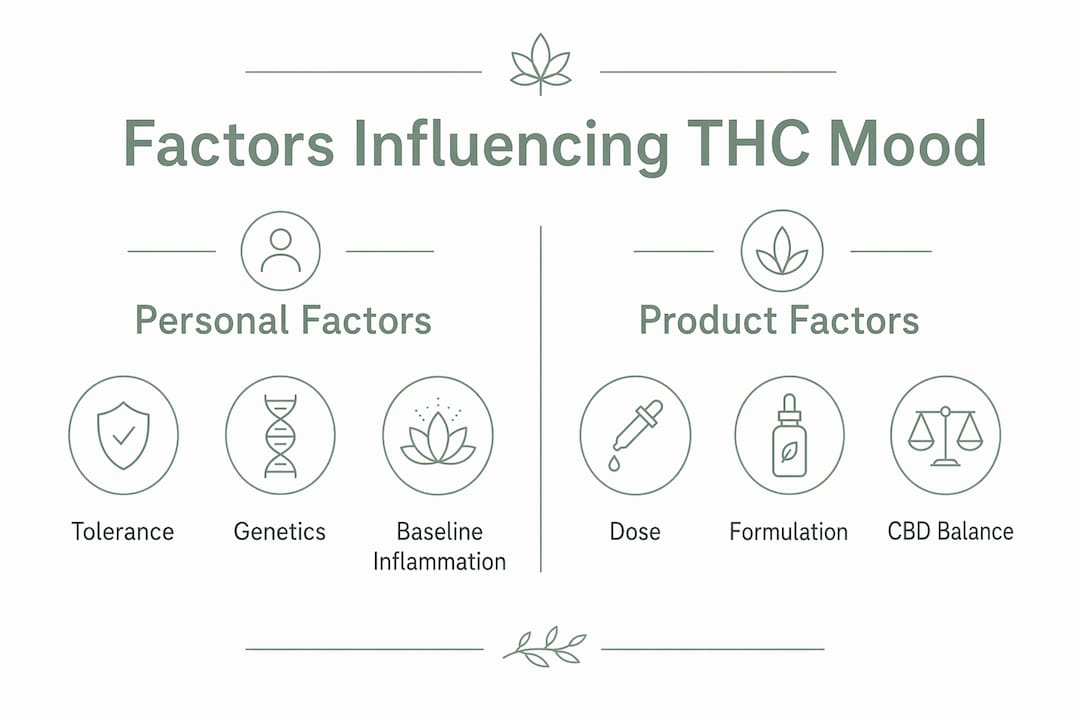
A 2025 Frontiers in Behavioral Neuroscience article found that baseline inflammatory status moderates THC response, with people carrying higher inflammatory load often showing varying mood benefits. Genetics also play a role: CYP enzyme variants affect how quickly 11-OH-THC is produced, and CB1 receptor availability varies between individuals.
Setting and expectancy are just as influential. Balanced-placebo research shows that belief about what you’ve consumed can shift stress and anxiety outcomes even when the active compound is absent. That means your mindset going in, and the social context around you, genuinely shape what you feel.
- Baseline inflammation: higher inflammatory status tends to produce less predictable mood outcomes
- Tolerance: regular users often need higher doses to reach the same effect, which increases risk at the high end
- Genetics: CYP metabolism speed and CB1 receptor density vary person to person
- Expectancy and setting: a calm, social environment with positive expectations consistently improves outcomes
How dose, formulation, and CBD balance change your experience
Dose and formulation are among the strongest levers you have. Low-to-moderate THC doses in balanced formulations tend to give more predictable, positive mood effects than high-THC-only products.
The dose-response curve for mood is inverted-U shaped. Moderate doses can reduce anxiety and lift mood; very high doses tip toward anxiogenic effects for many users. A meta-analysis of subjective THC effects found that inhaling a moderate THC dose increased feelings of being “high” and anxiety to a measurable extent on a 100-point scale. Oral doses showed less consistent subjective effects in that analysis, which reflects the slower, more variable absorption route.
CBD changes the picture meaningfully. The 2025 Frontiers behavioral neuroscience data found that products with moderate-to-high CBD content show more consistent mood benefits than high-THC-only options. A naturalistic tracker study found high-CBD/low-THC cannabis linked to the largest reductions in depression ratings among users. Understanding the biology behind CBD helps explain why: CBD modulates CB1 receptor activity without fully activating it, which tends to soften THC’s more anxiogenic edge.
Pro Tip: If you’re new to THC beverages or in a social setting, choose a product with 2–5 mg THC per serving and a balanced CBD:THC ratio. Track how you feel at 30, 60, and 90 minutes. That single session of notes will tell you more about your personal response than any general guide.
For more on what happens at the lower end of the dose range, Tryfloral’s breakdown of low dose THC effects is worth reading before you order.
Short-term mood benefits and risks you should know about
Short-term benefits include mild euphoria, relaxation, and reduced negative affect for many users. The risks, when they appear, are real: transient anxiety, paranoia, sleepiness, and impaired judgment.
An EMA cohort study found that oral THC doses in the low to mid double-digit mg range produced robust acute reductions in anxiety and depression in a clinical sample. A naturalistic app-based study of 1,819 cannabis users found 95.8% reported symptom relief from depression after consumption, with THC levels as the strongest predictor of that relief. Cannabis use was also associated with negative side effects corresponding to increased depression (such as feeling unmotivated) in up to 20% of users.
The honest picture: Daily EMA data from Scientific Reports (2026) found cannabis use associated with same-day anxiety reductions for many users, but the literature includes both anxiolytic and anxiogenic findings depending on dose and sample. Neither “THC always helps” nor “THC always hurts” is accurate.
Cannabis-naïve users and those taking higher doses face a meaningfully higher likelihood of negative mood effects. Impairment windows typically run 2–6 hours depending on dose, tolerance, and formulation. Driving during that window is not safe, regardless of how you feel subjectively.
- Positive effects (common at low-moderate doses): relaxation, mild euphoria, reduced anxiety, improved social ease
- Negative effects (more likely at high doses or in naïve users): anxiety, paranoia, confusion, sleepiness, impaired judgment
- Duration: most effects resolve within 2–6 hours; some (sleepiness) can persist longer
What the evidence says about long-term mood and depression risk
Long-term effects are genuinely uncertain. Some cohort data suggest increased depression risk with heavy chronic use, but results are mixed and depend heavily on use pattern, frequency, and context.
The biological mechanism is plausible. Neuroimaging and naturalistic data show lower CB1 receptor availability in cortical regions with heavy chronic use. Those changes appear at least partially reversible after days to weeks of abstinence, which is an important nuance that the doom-and-gloom headlines often skip. A Frontiers systematic review on cannabis and mood disorders found that while some observational studies link cannabis use to subsequent depression, others find no association after confounder adjustment.
The 2026 Frontiers in Pharmacology review notes that long-term depressive trajectories are complex and not fully resolved by current evidence. Observational designs, self-medication confounds, and the absence of large randomized trials all limit what we can confidently say.
Bottom line on long-term risk: moderate, occasional use by healthy adults carries a different risk profile than daily heavy use. The evidence does not support alarm about responsible social consumption, but it does support caution about escalating frequency.
A safety checklist for using THC beverages responsibly
Follow this checklist to steer your experience toward enjoyment and away from harm.
- Check the label first. Confirm mg THC per serving, CBD:THC ratio, and any declared onset/duration guidance.
- Start low. For most adults, 2–5 mg THC is a reasonable starting point; experienced users may go to 5–10 mg.
- Wait 60 minutes minimum before considering a second serving.
- Set matters. Choose a calm, comfortable environment, especially for your first session with a new product.
- Don’t mix with alcohol or benzodiazepines. Both interactions can amplify sedation and impair judgment unpredictably.
- Don’t drive. Impairment can persist 2–6 hours even when you feel “fine.”
- Eat something beforehand. Food slows absorption and tends to smooth the onset curve.
- Track your reaction. Note dose, timing, and how you felt at 30, 60, and 90 minutes.
A few additional notes for specific situations:
- Anxiety-prone users: start at 2 mg or less and prioritize high-CBD formulations; see Tryfloral’s THC beverages anxiety tips for more
- Sharing a variety pack socially: pace the group, not just yourself; remind friends to wait before re-dosing
- Prescription medications: THC can interact with antidepressants, antipsychotics, blood thinners, and sedatives; check with your prescriber before use
- Preexisting psychiatric conditions: consult a clinician before using THC if you have a history of psychosis, bipolar disorder, or severe anxiety
When to stop and when to get medical help
Stop use and seek help if you experience severe or persistent anxiety, panic attacks, suicidal thoughts, or prolonged functional impairment that doesn’t resolve within a day or two.
- Seek emergency care for: chest pain, severe confusion or hallucinations, loss of consciousness, or acute psychotic symptoms
- Contact a medical provider for: persistent worsening depression after use, signs of dependence (needing THC to feel normal, failed attempts to cut back), or concerning medication interactions
- Crisis resources: 988 Suicide and Crisis Lifeline (call or text 988), SAMHSA National Helpline (1-800-662-4357, free and confidential)
These reactions are uncommon with responsible low-dose use, but they’re real possibilities, especially for first-time users or those with underlying conditions.
How strong is the evidence, really?
The evidence base is mixed. Good experimental studies exist for acute effects; long-term causal evidence is limited and often observational.
Randomized controlled trials and meta-analyses give us solid ground on acute dose-response relationships. EMA and naturalistic cohort studies add real-world texture but can’t establish causation. The biggest gaps are in long-term outcomes, dose-response for oral/beverage routes specifically, and how CBD:THC ratios interact across different genetic profiles.
A note on reading the research: self-medication confounds are pervasive in cannabis mood research. People who use cannabis to manage anxiety or depression already have those conditions, which makes it genuinely hard to separate cause from effect in observational data. Treat any headline claiming cannabis “causes” or “cures” depression with appropriate skepticism until you’ve checked the study design.
For deeper reading, the sources listed below represent the strongest available evidence as of 2025–2026.
Key Takeaways
THC commonly produces short-term mood uplift at low-to-moderate doses, but dose, CBD balance, and personal biology determine whether that effect is positive or anxiogenic.
| Point | Details |
|---|---|
| Low doses tend to lift mood | 2–5 mg THC typically produces relaxation or mild euphoria; higher doses increase anxiety risk. |
| Wait before re-dosing | Peak effects arrive at 45–60 minutes; re-dosing early is the most common cause of adverse reactions. |
| CBD balance matters | Moderate-to-high CBD content produces more consistent mood benefits than high-THC-only formulations. |
| Long-term evidence is limited | Chronic heavy use may affect CB1 receptor availability, but effects appear reversible; occasional use carries a different risk profile. |
| Tryfloral for transparent dosing | Tryfloral’s farm-to-fridge beverages list mg per serving and CBD:THC ratios clearly, supporting the start-low approach. |
A note on what I watch for with THC beverages
The most consistent mistake I see in conversations about THC and mood is treating dose as the only variable. It isn’t. Two people can drink the same 5 mg seltzer in the same room and have genuinely different experiences, because their baseline stress levels, inflammatory status, and expectations going in are all different. The neuroscience backs that up.
What I’d encourage you to do is treat your first few sessions with any new THC beverage as information-gathering, not just enjoyment. Note the dose, the timing, what you ate, and how you felt at each stage. That data is more useful than any general guide, including this one. Responsible use isn’t about being cautious to the point of not enjoying yourself. It’s about knowing your own response well enough to make good choices.
Tryfloral’s farm-to-fridge THC beverages
If you’re ready to put this guidance into practice, Tryfloral makes it straightforward. Every can lists the exact mg THC per serving and CBD:THC ratio, so you can apply the start-low approach without guesswork. The farm-to-fridge process means the hemp is grown and processed in-house, giving you ingredient transparency from source to sip.
The Harvest Apple THC Seltzer is a good starting point: zero calories, clearly labeled, and designed for social enjoyment. Build your own case to mix serving sizes and CBD profiles across your first few sessions. Before you order, run through the safety checklist above, especially if you’re new to THC beverages or trying a new potency level.
This article is general information, not medical or legal advice. Confirm current regulations in your state and consult a qualified healthcare provider for your specific situation.
Selected sources and further reading
| Source | What it contributes |
|---|---|
| Frontiers in Pharmacology review | Mechanism review: THC, endocannabinoid modulation, and downstream mood effects |
| BMC Psychiatry IV-THC trial | Acute dose timing: peak subjective effects at 45–60 minutes, pharmacokinetics of 11-OH-THC |
| Frontiers in Behavioral Neuroscience article | CBD moderation of THC mood effects; baseline inflammation as a moderator |
| EMA cohort: medicinal cannabis and mood (PMC) | Acute and sustained anxiety/depression reductions in clinical sample; dose bands |
| Naturalistic cannabis and depression (PMC) | Real-world symptom relief data; THC as strongest predictor; side effect prevalence |
| Placebo and expectancy effects (PMC) | Expectancy and setting as mood moderators in cannabis research |
| Frontiers systematic review on cannabis and mood disorders | Long-term evidence overview; observational limitations; mixed findings on depression risk |
| Scientific Reports EMA daily-record study (2026) | Same-day anxiety reductions; nuanced anxiolytic vs. anxiogenic findings by dose/sample |
