

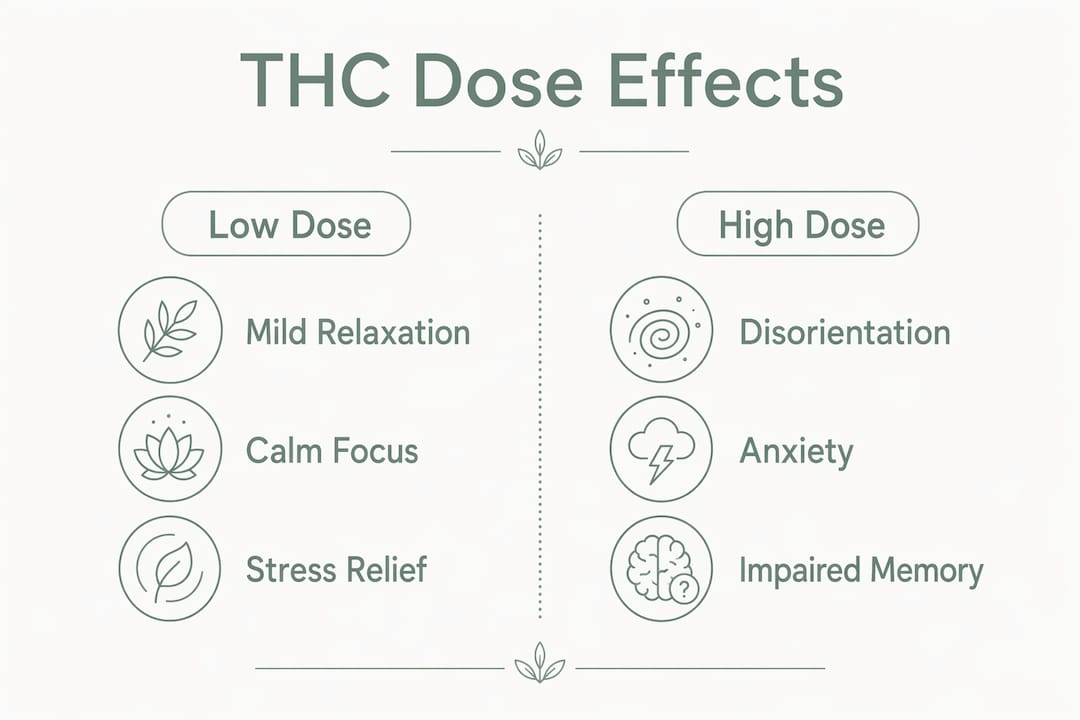
Low-dose THC delivers mild, functional effects that most adults find genuinely pleasant without the disorienting high that puts people off cannabis entirely. Specifically, a low dose is often regarded as a small amount per serving, with a modest starting dose recommended for beginners and slightly higher amounts for those comfortable with some tolerance. At these amounts, you can expect subtle relaxation, a light mood lift, and reduced stress without meaningful cognitive impairment, as reported by many users.
The science behind this is worth knowing. A randomized controlled study by researchers at the University of Illinois at Chicago and the University of Chicago found that 7.5mg reduced stress in a simulated public-speaking task, while 12.5mg actually increased anxiety and negative mood. That finding captures the core principle of low-dose THC use: the difference between relief and discomfort is often just a few milligrams.
Here is what you can typically expect at increasing dose levels:
- Low amounts: Gentle relaxation, barely perceptible mood shift, no impairment. Good starting point for beginners.
- Moderate amounts: Noticeable calm, mild physical ease, slight mood elevation. Functional for daytime or social use.
- Higher amounts: More pronounced effects, possible light euphoria, some cognitive softening. Approaching the threshold where effects become less predictable.
- Very high amounts: Full psychoactive experience, higher risk of anxiety or paranoia, especially for those without tolerance.
The goal of low-dose use is finding your personal therapeutic window: enough THC to feel the benefit, not so much that the experience tips into discomfort.
Table of Contents
- How low-dose THC actually affects your brain
- Low dose vs. high dose: how the effects actually compare
- Benefits and risks of low-dose THC for adults
- How to use low-dose THC safely and effectively
- Tryfloral makes low-dose THC easy to get right
- Key Takeaways
How low-dose THC actually affects your brain
THC works by binding to CB1 cannabinoid receptors concentrated in the brain and central nervous system. At low doses, this binding gently enhances your endocannabinoid system’s natural activity without overwhelming it. The result is a modulated stress response and a calmer baseline mood, not a dramatic alteration of perception.

One of the most clinically relevant details here is receptor sensitivity. Research published in Molecular Psychiatry on cannabinoid receptor dynamics shows that low doses preserve CB1 sensitivity, preventing the tolerance buildup that comes with heavier use. When receptors stay sensitive, your body keeps responding predictably to the same dose over time.
THC also influences serotonin pathways. Preclinical research in rhesus macaques published in Science Advances found that long-term low-dose THC increased serotonin production alongside reduced inflammation markers. While that study focused on HIV treatment side effects, the serotonin finding points toward why many people report improved mood at low doses.
| Brain mechanism | Low-dose effect | High-dose effect |
|---|---|---|
| CB1 receptor activation | Gentle modulation, sensitivity preserved | Receptor downregulation, tolerance develops |
| Serotonin activity | Mild increase, mood support | Disrupted, possible dysphoria |
| Stress response | Reduced, faster recovery | Elevated, prolonged |
| Cognitive function | Largely intact | Impaired attention and memory |
Pro Tip: If you are new to THC beverages or edibles, the liver converts ingested THC into 11-hydroxy-THC, a more potent compound with a longer duration. This is why a 5mg edible can feel stronger than 5mg inhaled. Start at the lower end of any dose range when consuming orally.
Low dose vs. high dose: how the effects actually compare
The biphasic dose-response is an important concept for anyone using THC intentionally. At low doses, THC can calm anxiety and lift mood. Exceeding a personal threshold may produce anxiety, paranoia, and cognitive fog.
Clinical guidance from Health Canada aligns with this pattern: low doses of THC may have anxiolytic and mood-elevating effects, while high doses have been associated with anxiety and lowered mood. Similar patterns are observed regarding sleep, with low doses potentially improving sleep onset and quality, while high doses may disrupt sleep.
Key differences worth keeping in mind:
- Low dose benefits: Stress relief, functional calm, preserved cognition, social ease, lower risk of adverse effects.
- Low dose risks: Mild sedation, possible drowsiness, minor motor coordination changes in sensitive individuals.
- High dose risks: Paranoia, anxiety, impaired memory and attention, cardiovascular stress, unpleasant dissociation.
- Tolerance: Frequent high-dose use triggers CB1 receptor downregulation, meaning you need more THC over time to feel the same effect. Low-dose protocols largely avoid this cycle.
The practical takeaway is that more THC is not better THC. The effects of low THC are often more consistent, more enjoyable, and far easier to manage than those of higher doses.
Benefits and risks of low-dose THC for adults
The benefits of low-dose THC are well-supported by both clinical research and real-world use. At 1–5mg, most adults experience:
Benefits:
- Reduced stress and anxiety, particularly in social or performance situations
- Mild physical relaxation without sedation
- Gentle mood elevation and a sense of ease
- Improved sleep onset at low doses, per clinical evidence from Health Canada’s cannabinoid guidance
- Potential pain relief, with very low doses (under 3mg) showing therapeutic benefit with minimal psychoactive side effects in chronic pain research
Risks (even at low doses):
- Mild sedation or drowsiness, especially with edibles
- Slight impairment of fine motor skills in sensitive individuals
- Possible interaction with medications, particularly sedatives, blood thinners, and antidepressants
- Not recommended for adults under 25, pregnant or breastfeeding people, or anyone with a personal or family history of psychotic disorders
Population context matters here. The effects of low THC are dose-dependent and also vary by individual biology, body weight, prior cannabis experience, and whether you have eaten recently. What feels like a gentle 2.5mg to one person may feel more intense to another.
Pro Tip: If you are anxiety-prone, look for products with a higher CBD-to-THC ratio. Clinical trial data published in Neuropsychopharmacology shows that higher CBD:THC ratios reduce total THC intake and mitigate side effects, even when CBD alone does not fully blunt THC’s psychoactive properties.
One group that benefits particularly from low-dose approaches is anyone new to cannabis. Starting at 1–2.5mg gives you a clear read on how your body responds before you consider going higher. You can always take more next time. You cannot un-take what you have already consumed.
How to use low-dose THC safely and effectively
Getting the dose right is the whole game with THC. Clinical dosing protocols published in Pain and Therapy (2024) recommend starting at 2.5mg daily and increasing by 2.5mg weekly increments until you find the dose that delivers the effect you want without side effects. This approach is sometimes called “start low, go slow,” and it works because it gives your endocannabinoid system time to calibrate.
Here is a practical progression for adults new to low-dose THC:
- Week 1: Take 2.5mg in the evening, after a meal. Note how you feel at 30 minutes, 1 hour, and 2 hours.
- Week 2: If effects were too subtle, increase to 5mg. If they were comfortable, stay at 2.5mg.
- Week 3 onward: Adjust in 2.5mg increments based on your response. Most adults find their sweet spot between 2.5mg and 5mg for functional effects without intoxication.
- Re-dosing rule: Wait at least 2 hours before taking more, especially with edibles or beverages. The 11-hydroxy-THC conversion in the liver delays onset, and re-dosing too early is the most common reason people accidentally take too much.
- Tolerance check: If you are using THC daily, take a 2-day break every 2–3 weeks. This helps maintain CB1 receptor sensitivity and keeps your effective dose stable.
The consumption method shapes the experience significantly. Here is how the main formats compare:
| Method | Onset time | Peak duration | Potency notes |
|---|---|---|---|
| Beverage | 30 minutes | 3–5 hours | Consistent dosing, liver metabolism applies |
| Tincture (sublingual) | — | 2–4 hours | Faster than edibles, more predictable |
| Edible (food) | 30 minutes | 4 hours | Strongest 11-hydroxy-THC conversion |
| Inhalation | 2–10 minutes | 1–3 hours | Fast onset, harder to dose precisely |
THC beverages sit in a particularly useful middle ground. They absorb faster than traditional edibles because liquid moves through the digestive system more quickly, and they make it easy to sip gradually rather than committing to a full dose at once. If you want to explore low-dose THC drinks as a format, the controlled dosing is one of the clearest advantages over other oral methods.

Pro Tip: Always check the milligrams per serving on any THC product, not just the total milligrams in the package. A bottle labeled “10mg THC” with two servings means 5mg per serving, which is a meaningful difference for a beginner. For a detailed breakdown of how to read THC drink labels and find your ideal dose, the THC drink dosage guide from Tryfloral is a practical starting point.
If you take prescription medications or have a chronic health condition, talk to your doctor before adding THC to your routine. Drug interactions are real, particularly with medications that affect the liver’s cytochrome P450 enzyme system, which processes both THC and many common drugs.
Tryfloral makes low-dose THC easy to get right
If you have read this far, you already know that dose precision is everything with THC. Tryfloral was built around exactly that idea. As a farm-to-fridge THC beverage brand, Tryfloral controls the production process from the source plant to the can in your hand, so the milligrams on the label are the milligrams you actually get.
Each Tryfloral seltzer is zero calories, precisely dosed, and designed for the kind of functional, enjoyable experience this article describes: a mild buzz that fits into your day without taking over it. The Harvest Apple THC Seltzer and Tropical THC Seltzer are both popular starting points for adults new to low-dose cannabis beverages. The format makes it easy to sip slowly, monitor how you feel, and stay well within your personal therapeutic window.
The farm-to-fridge difference is what separates Tryfloral from generic cannabis products: full traceability, consistent potency, and a product made for adults who want to enjoy THC responsibly. Browse the full lineup and find the dose and flavor that fits your lifestyle.
Key Takeaways
Low-dose THC in small amounts reliably produces mild relaxation and stress relief in adults, with clinical research supporting that staying within a low dose keeps effects pleasant and generally anxiety-free.
| Point | Details |
|---|---|
| Effective dose range | Small doses cover most adults; beginners should start low and adjust cautiously. |
| Biphasic response | Low doses may relieve stress; higher doses can increase anxiety and negative mood. |
| Method matters | Beverages and edibles convert THC to 11-hydroxy-THC in the liver, influencing strength and duration compared to inhaled THC. |
| Tolerance management | Low-dose use may preserve CB1 receptor sensitivity, supporting consistent effects over time. |
| Tryfloral | Precisely dosed THC seltzers designed for functional low-dose use, with full farm-to-fridge traceability. |
