

THC affects productivity through dose-dependent changes in working memory, attention, and motivation. At low doses of 2.5–5mg, it can reduce anxiety and support creative thinking. At higher doses, it impairs the cognitive functions you rely on most at work. Understanding how THC affects productivity explained through recent research gives you a real advantage. About 15.9% of full-time adults report using cannabis in the past month. That number reflects how common this question has become for working professionals and creatives who want honest, practical answers.
How THC affects productivity: the cognitive science explained
THC binds to cannabinoid receptors in the brain’s prefrontal cortex, the region responsible for planning, decision-making, and sustained attention. This binding disrupts the neural signals that keep your working memory sharp and your focus locked in. The result is a predictable pattern of cognitive slowdown that varies by dose, biology, and task type.
THC impairs working memory, sustained attention, and reaction time for 3–8 hours after use. Spatial working memory deficits can persist for up to 22 hours. That means you could feel completely sober by morning and still be operating below your cognitive baseline.

The dose threshold matters enormously. Research shows that doses above 10mg disrupt working memory and reasoning in measurable ways. Low doses in the 2.5–5mg range produce far milder cognitive disruption and may even support certain types of thinking.
One finding that surprises most professionals: THC impairs metacognition, meaning you cannot accurately judge your own performance while intoxicated. You may feel sharp and productive while making errors you would normally catch. That gap between perceived and actual output is one of the most underappreciated risks of cannabis use during work hours.
Pro Tip: If you use THC in the evening and have precision work the next morning, build in at least 8–12 hours of buffer time. Feeling sober is not the same as being cognitively clear.
| Cognitive function | Effect at low dose (2.5–5mg) | Effect at high dose (10mg+) |
|---|---|---|
| Working memory | Mild reduction | Significant impairment |
| Sustained attention | Slight decrease | Marked disruption |
| Reaction time | Minimal change | Noticeably slower |
| Spatial memory | Modest effect | Deficits lasting up to 22 hours |
| Creative thinking | Possible improvement | Inconsistent or impaired |
How does THC influence motivation and creative output?
THC’s relationship with motivation is more nuanced than most people assume. The compound does not directly boost focus or raw cognitive power. Productivity gains from THC largely reflect anxiety reduction rather than any enhancement of mental processing. For professionals whose biggest productivity barrier is anxiety or mental noise, that distinction matters.
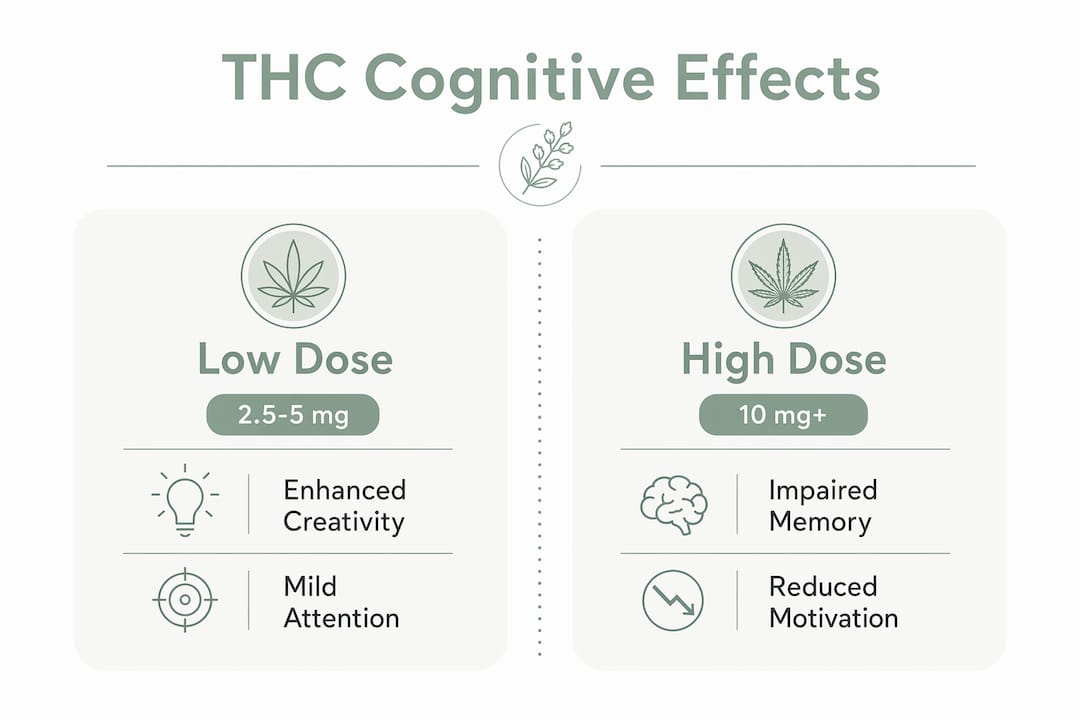
At low doses, THC can increase divergent thinking, the kind of lateral, associative thought that fuels brainstorming sessions, creative writing, and design work. This is why many creatives report feeling more generative after a small amount. The effect is real, but it is context-dependent and dose-sensitive.
Heavy or chronic use tells a different story. Frequent high-dose consumption is linked to reduced motivation, flattened drive, and lower output over time. The so-called “amotivational syndrome” remains debated in clinical literature, but the pattern shows up consistently in people who use cannabis daily at significant doses.
- Low doses (2.5–5mg) reduce performance-inhibiting anxiety without major cognitive cost
- Divergent thinking and brainstorming benefit more than analytical or precision tasks
- Chronic high-dose use correlates with reduced motivation and lower workplace output
- CBD reduces stress distraction without significant cognitive impairment, making it a cleaner option for anxiety-related productivity barriers
- The subjective feeling of being creative does not always match actual creative output
Pro Tip: For creative sessions, try a low-dose THC option and pair it with a defined task. Open-ended “I’ll see what happens” sessions tend to drift. Structure keeps the session productive.
Which tasks are most affected by THC’s cognitive effects?
Not all work is equally vulnerable to THC’s effects. The type of task you are doing determines how much THC will help or hurt your output. This is one of the most practical frameworks for thinking about cannabis use and work performance.
Precision and analytic work takes the hardest hit. Legal drafting, financial modeling, data analysis, and coding that requires logical accuracy all depend on the exact cognitive functions THC disrupts most: working memory, sustained attention, and error detection. THC impairs analytical and precision-based productivity while showing more tolerance for creative, lateral-thinking tasks.
Safety-sensitive roles carry a separate category of risk. Impaired coordination and slower reaction time create real hazards for anyone operating machinery, driving, or managing physical environments. The cognitive impairment from THC can outlast the subjective high by many hours, which means post-use risk extends well beyond the period when someone feels intoxicated.
Creative and repetitive tasks sit in a different position. Writers, designers, musicians, and people doing routine physical work often report that low-dose THC helps them stay in flow without the mental friction that slows them down. The key word is “low-dose.” The same tasks become harder when the dose climbs above the 10mg threshold.
Individual variation also plays a real role. Two people with similar tolerance levels can respond very differently to the same dose. Without personal experimentation under low-stakes conditions, predicting your own response is genuinely difficult.
What role do dosage, biology, and tolerance play?
Dose is the single most controllable variable in how THC affects your cognitive output. Microdosing, typically defined as 2.5–5mg per session, has become the preferred approach for professionals who want to use THC without sacrificing work quality. At this range, the anxiety-reducing effects tend to show up without the working memory disruption that higher doses produce.
Biological sex is a less-discussed but well-documented factor. Males show greater visuospatial working memory impairment than females in controlled studies. This difference is not about tolerance or frequency of use. It reflects underlying biological differences in how THC interacts with the brain’s spatial processing systems.
Tolerance changes the subjective experience of THC but does not reliably protect cognitive function. Regular users often feel less intoxicated at the same dose, which can create a false sense of security. You can read more about this in Tryfloral’s breakdown of THC and high tolerance users.
- Start at 2.5mg and wait at least 90 minutes before considering more
- Track your output on days you use THC versus days you do not
- Recognize that feeling less high does not mean performing at full capacity
- Males should apply extra caution for spatial and precision tasks
- Use low-dose options consistently rather than escalating dose over time
How can professionals use THC responsibly without hurting their work?
Responsible use starts with timing. For inhaled cannabis, a wait time of 8–12 hours between use and cognitively demanding work is a reasonable baseline. Edibles metabolize more slowly and can produce longer-lasting effects, so the buffer should extend further. Tryfloral’s guide on THC beverage after-effects covers what to expect from beverage-format THC specifically.
- Know your task demands before you use. Precision work, deadlines, and safety-sensitive tasks call for full cognitive capacity. Save THC for off-hours or low-stakes creative sessions.
- Use behavioral self-checks, not just how you feel. THC blood or urine levels do not reliably indicate real-time cognitive impairment. A simple timed task or memory check gives you more useful information than your subjective sense of clarity.
- Consider CBD as a daytime alternative. CBD modulates anxiety without directly impairing cognition, making it a practical option when you need to take the edge off without affecting your output. Tryfloral’s post on CBD for social anxiety explains this well.
- Stick to measured doses. Beverage-format THC products make dosing easier to control than smoked or vaped cannabis, where the amount absorbed varies significantly.
- Build a personal use log. Note the dose, time, consumption method, and your output quality that day. Patterns emerge quickly and give you real data on your own response.
Key Takeaways
THC impairs working memory and attention at doses above 10mg, while low doses of 2.5–5mg may support creative thinking by reducing anxiety rather than enhancing raw cognition.
| Point | Details |
|---|---|
| Dose determines impact | Low doses (2.5–5mg) carry far less cognitive risk than doses above 10mg. |
| Impairment outlasts the high | Spatial memory deficits can persist up to 22 hours, even when you feel sober. |
| Task type shapes the risk | Precision and analytic work suffers most; creative and lateral tasks are more tolerant of low-dose use. |
| Biology affects response | Males show greater visuospatial working memory impairment than females in controlled studies. |
| Behavioral checks beat blood tests | Self-administered cognitive tasks are more reliable indicators of impairment than THC levels in blood or urine. |
What I’ve learned about THC and real-world productivity
The research confirms what I have observed over time: the gap between feeling productive and actually being productive is where most people get tripped up with THC. You feel sharp. You feel creative. You feel like the ideas are flowing. But the metacognitive impairment means you are often the last person to notice when the output quality drops.
The professionals I have seen use THC most effectively treat it like a precision tool, not a general-purpose one. They use low doses, they pick the right task type, and they do not use it when the stakes are high. They also do not confuse anxiety relief with cognitive enhancement. Those are two very different things, and conflating them leads to poor decisions about when and how much to use.
The gender difference in visuospatial impairment is something most people have never heard of, and it matters. If you are male and doing spatial or precision work, your risk profile is measurably higher than you might assume. That is not a reason to avoid THC entirely. It is a reason to be more deliberate about dose and timing.
My honest advice: treat your first few low-dose sessions as data collection, not recreation. You will learn more about your personal response in three structured sessions than from years of casual use. And that knowledge is what actually lets you use THC responsibly without sacrificing what you have worked hard to build.
— Adam
Tryfloral’s approach to THC you can actually count on
Controlled dosing is the foundation of responsible THC use, and that starts with knowing exactly what is in your drink.
Tryfloral’s farm-to-fridge THC seltzers are built for adults who want a predictable, low-calorie experience without the guesswork of smoked or vaped cannabis. Each can delivers a measured dose so you can stay in the 2.5–5mg range that research supports for creative use. The Harvest Apple THC Seltzer is a clean, zero-calorie option that fits naturally into an evening wind-down or a low-key social setting. If you want to understand what makes Tryfloral’s sourcing different, the farm-to-fridge process is worth a look. Please enjoy responsibly, and only if you are of legal drinking age in your state.
FAQ
How long does THC impair cognitive function?
THC impairs working memory, attention, and reaction time for 3–8 hours after use. Spatial memory deficits can last up to 22 hours, even after the subjective high fades.
Does THC help or hurt creative work?
Low doses of 2.5–5mg may support divergent thinking and reduce anxiety that blocks creative output. Doses above 10mg tend to disrupt the working memory needed for sustained creative work.
Can you accurately judge your own productivity while using THC?
No. THC impairs metacognition, meaning users consistently overestimate their performance and miss errors they would normally catch. Behavioral self-checks are more reliable than how you feel.
Does tolerance protect you from THC’s cognitive effects?
Tolerance reduces the subjective sense of intoxication but does not reliably prevent cognitive impairment, particularly spatial working memory deficits. High-tolerance users can still underperform on precision tasks.
Is CBD a better option for productivity than THC?
For professionals whose main barrier is anxiety, CBD reduces stress-related distraction without the cognitive impairment associated with THC, making it a more practical daytime option.
