

THC produces its effects by binding to CB1 receptors in the brain, but frequent use causes those receptors to downregulate, meaning how THC affects high tolerance users is fundamentally different from how it hits someone who uses occasionally. The brain adapts to constant cannabinoid signaling by reducing both the number and sensitivity of CB1 receptors. That adaptation explains why your third year of daily use feels nothing like your first month, and why simply smoking more rarely solves the problem.
How THC affects high tolerance users at the biochemical level
The core mechanism behind tolerance and THC effects is CB1 receptor downregulation. When THC binds to CB1 receptors repeatedly, the brain responds by pulling those receptors inward through a process called internalization, effectively hiding them from the cell surface. Fewer available receptors means weaker signal transmission, which translates directly into diminished effects for the user.
A 2012 PET imaging study of chronic daily cannabis smokers, published in Molecular Psychiatry (Hirvonen et al.), found roughly 20% lower CB1 receptor density in the cortical and limbic regions tied to mood and cognition compared with non-users — a reduction the researchers observed reversed after about four weeks of abstinence. A drop of that size in receptor availability means the same dose of THC produces a fraction of its original effect.

What makes this especially relevant for high tolerance cannabis use is the regional selectivity of that downregulation. Tolerance does not develop evenly across the brain. The receptors responsible for euphoric effects tend to downregulate faster than those linked to anxiety responses. This means the pleasant, mood-lifting effects fade first, while the anxiety-producing pathways remain more active. The result is a user who needs more THC to feel good but is simultaneously more vulnerable to feeling anxious.
Here is what that looks like in practice:
- Euphoric effects diminish early, often within weeks of daily use
- Anxiolytic effects (the calming, anti-anxiety response) also weaken, but more slowly
- Anxiogenic effects (the anxiety-inducing response) remain relatively intact longer
- Cognitive impairment from acute doses decreases, as CB1 downregulation allows high tolerance users to function with less acute disruption
Pro Tip: If your sessions feel flat but you are still occasionally getting anxious, that is a textbook sign of uneven regional tolerance. You have lost the euphoria but kept the anxiety risk.
What is THC’s biphasic dose response and why does it matter for tolerance?
THC displays a biphasic dose response on anxiety. Low doses reduce anxiety; high doses increase it. This is not a fringe observation. THC’s biphasic anxiety response is well documented, and for high tolerance users, it creates a specific and frustrating trap.
Here is how the trap works:
- Your tolerance rises, so the dose that once produced calm and euphoria no longer does.
- You increase your dose to chase the original effect.
- The higher dose crosses the anxiogenic threshold, triggering anxiety instead of relief.
- You interpret the anxiety as needing even more THC, escalating further.
The threshold dose does not stay fixed. Tolerance shifts it upward for euphoric effects but not proportionally for anxiety effects. So the gap between “enough to feel good” and “too much and now anxious” narrows considerably for frequent users.
“Increasing THC doses to overcome tolerance can push users into anxiety-producing doses, worsening symptoms rather than relieving them.” — Cannabis Anxiety and Tolerance Dynamics
This is why many long-term users report that cannabis stopped working for anxiety. The THC beverages anxiety management conversation is directly tied to this biphasic reality. It is not that cannabis stopped working entirely. It is that the dose window for therapeutic benefit has shifted and, in many cases, narrowed to the point where hitting it consistently becomes difficult.
Clinical observations confirm that cannabis-induced anxiety in high tolerance users often arises from neuroadaptation-related withdrawal symptoms, not from an underlying anxiety disorder. That distinction matters because it changes how you approach the problem.
How long does tolerance take to develop and reverse?
Tolerance development speed depends on frequency and dose, but the timeline is faster than most users expect. An analysis of 120,000 cannabis sessions found that therapeutic symptom relief decreases by roughly 0.5% per session, adding up to a 10% loss after just 20 sessions. For a daily user, that is less than three weeks.
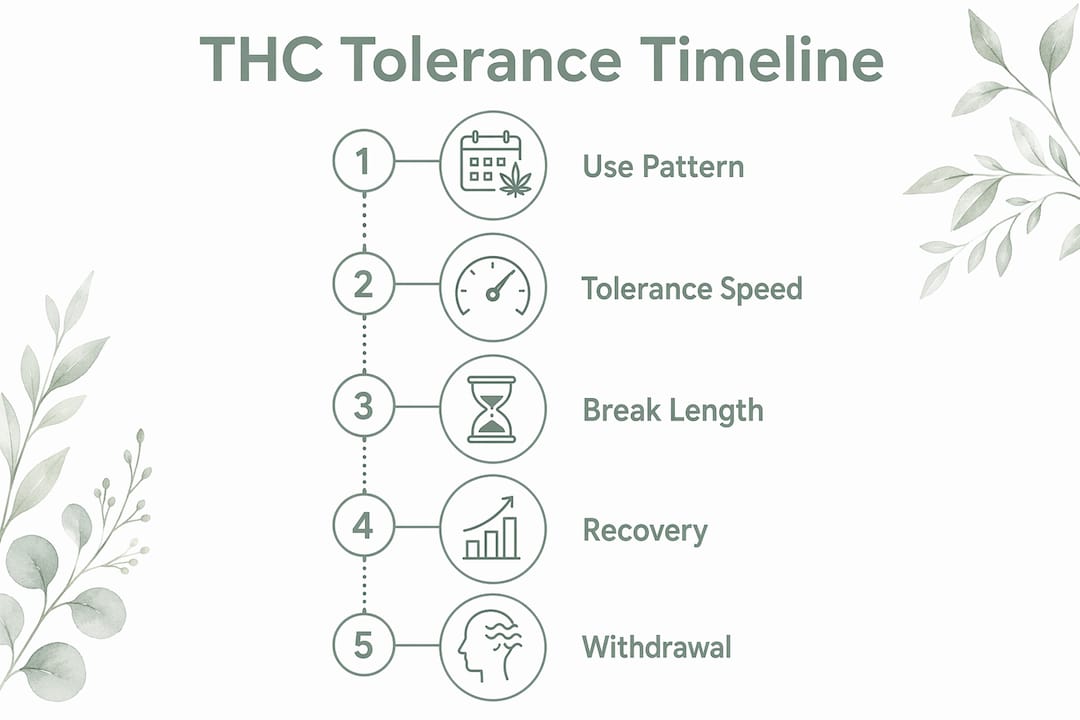
| Use Pattern | Tolerance Development | Recommended Break Length |
|---|---|---|
| Occasional (2-3x per week) | Slow, several months | 7 days |
| Regular (daily) | Moderate, 4-6 weeks | 14 days |
| Heavy (multiple times daily) | Fast, 2-4 weeks | 21-28 days |
| Very heavy (high-dose daily) | Rapid, under 2 weeks | 28+ days with supervision |
CB1 receptor availability typically recovers to near baseline after four weeks of abstinence. Shorter breaks yield partial recovery, which still translates to noticeably improved sensitivity when you return to use. A seven-day break will not fully reset your receptors, but it will meaningfully shift your experience.
One complication worth knowing: cannabis withdrawal symptoms like irritability and anxiety during breaks are frequently mistaken for the original anxiety the user was treating. This creates a false signal that the break is making things worse, when in reality it is the neuroadaptation process working as expected. Knowing this in advance makes it much easier to stay the course.
Pro Tip: Track your mood and sleep during a tolerance break starting from day three onward. Symptoms typically peak around days two through four and improve significantly by day seven. If you see that pattern, your brain is resetting, not breaking down.
Genetic factors also play a role. Variations in the CNR1 and FAAH genes affect individual receptor downregulation speed and recovery rate. This explains why two people with identical use patterns can have very different tolerance experiences.
How can high tolerance users manage or reset their THC sensitivity?
Managing high tolerance cannabinoid impact does not require quitting entirely. It requires a more deliberate approach to dose, product choice, and timing. Here are the strategies backed by current evidence:
- Microdosing: Drop your dose to the lowest amount that produces any noticeable effect. This keeps CB1 receptors engaged without driving further downregulation. Many users find that 2.5 to 5mg of THC produces real effects once they step back from higher doses.
- Structured tolerance breaks: Clinical guidance recommends medically supervised breaks and dose titration for heavy users. Even a two-week break significantly improves receptor sensitivity for most people.
- Micro-breaks: If a full break is not practical, alternating two days on and one day off can slow the rate of further downregulation without requiring full abstinence.
- Balanced THC:CBD products: CBD acts as a negative allosteric modulator of CB1 receptors, meaning it changes the receptor’s shape in a way that reduces THC’s binding aggressiveness. Using products with a 1:1 or 2:1 THC:CBD ratio may slow tolerance development over time.
- Product rotation: Switching between delivery methods, such as moving from smoking to a controlled-dose THC beverage, gives you more precise dosing and reduces the risk of accidentally overshooting your therapeutic window.
- Lower-potency products: High-THC flower and concentrates accelerate downregulation. Choosing products in the 5 to 10mg THC range gives you more control and a longer runway before tolerance becomes a problem again.
For users exploring hemp-based alternatives as part of a rotation strategy, CBD-dominant or balanced products can serve as a practical bridge during partial tolerance breaks.
Key takeaways
High tolerance users experience diminished and altered THC effects because CB1 receptor downregulation reduces both receptor count and sensitivity, a process that is reversible with structured breaks.
| Point | Details |
|---|---|
| CB1 downregulation drives tolerance | Daily use reduces CB1 receptor availability by 20-30%, directly weakening THC’s effects. |
| Euphoria fades faster than anxiety | Uneven regional tolerance means users lose pleasant effects before losing anxiety risk. |
| Biphasic response creates a dose trap | Higher doses meant to restore euphoria can push users past the anxiogenic threshold. |
| Receptor recovery takes 7-28 days | Break length should match use intensity; full recovery typically requires four weeks. |
| CBD slows tolerance development | Balanced THC:CBD products reduce receptor downregulation rate and extend the therapeutic window. |
Why I think most people misread their own tolerance
I have talked with a lot of cannabis consumers who describe their tolerance as a problem they need to power through. They buy stronger products, use more frequently, and then wonder why they feel worse instead of better. The biology here is clear: that approach accelerates the exact process causing the problem.
What I find more useful is treating tolerance as information. Your brain is telling you the current dose and frequency are no longer calibrated to your receptor availability. That is not failure. It is a reversible biological response that responds predictably to the right interventions.
The part most people skip is the distinction between withdrawal anxiety and original anxiety. When you take a break and feel worse for a few days, that discomfort is neuroadaptation, not proof that you need cannabis. Pushing through that window is where most tolerance resets actually succeed or fail.
My honest recommendation: treat a tolerance break like a recalibration, not a punishment. Come back with a lower dose, a more controlled product format, and a clearer sense of your actual therapeutic window. You will get more out of cannabis long-term by using less of it more deliberately.
— Adam
Try Tryfloral for controlled dosing and real transparency
If you are managing tolerance and want a product that makes precise dosing actually possible, Tryfloral’s THC seltzers are worth your attention. Each can delivers a consistent, measured dose of THC with zero calories, so you are not guessing how much you consumed or dealing with the variability of smoked or edible formats.
Tryfloral sources its THC through a farm-to-fridge process that prioritizes quality and consistency from plant to can. For tolerance management specifically, that consistency matters. You need to know exactly what you are taking to stay within your therapeutic window. The Harvest Apple THC Seltzer is a great starting point if you are stepping back from higher-dose formats and want something light, social, and easy to control. Please enjoy responsibly, and you must be of legal age to purchase.
FAQ
How does THC affect users with high tolerance differently?
High tolerance users experience weaker euphoric effects and a narrowed dose window for anxiety relief because CB1 receptor downregulation reduces receptor availability by 20 to 30%. The brain’s adaptation means the same dose produces significantly less effect than it did early in use.
How long does a tolerance break need to be?
CB1 receptor availability recovers to near baseline after approximately four weeks of abstinence. Lighter users may see meaningful recovery in seven to fourteen days, while heavy daily users typically need the full 28-day window.
Can CBD help with THC tolerance?
CBD acts as a negative allosteric modulator of CB1 receptors, which reduces THC’s binding aggressiveness and may slow the rate of receptor downregulation. Using balanced THC:CBD products is a practical strategy for extending your therapeutic window.
Why does cannabis cause more anxiety as tolerance builds?
CB1 downregulation reduces euphoric effects faster than anxiety-producing effects, creating an imbalance. Higher doses used to compensate can push users past THC’s biphasic threshold into anxiety-inducing territory, worsening the experience rather than improving it.
Is cannabis tolerance permanent?
Tolerance is a reversible biological process. With structured breaks and dose reduction, CB1 receptor availability recovers and sensitivity returns. Genetic factors influence the speed of both development and recovery, but no evidence suggests permanent receptor damage from typical cannabis use.
