

THC seltzers are cannabis-infused sparkling beverages, and many contain little to no sugar and only a few calories per can — far fewer than the roughly 120 to 150 calories in a standard 5-ounce glass of wine. That gap is not trivial. For health-conscious adults who enjoy a social drink without derailing their nutrition goals, understanding how THC seltzers compare to wine calories is the first step toward making a smarter choice. The calorie difference comes down to one core fact: alcohol itself carries 7 calories per gram, and wine is mostly alcohol. THC, by contrast, contributes almost no calories on its own. Brands like Tryfloral have built their entire product line around this reality, offering zero-calorie THC seltzers designed for adults who want the social experience without the caloric cost.
How do THC seltzers compare to wine calories?
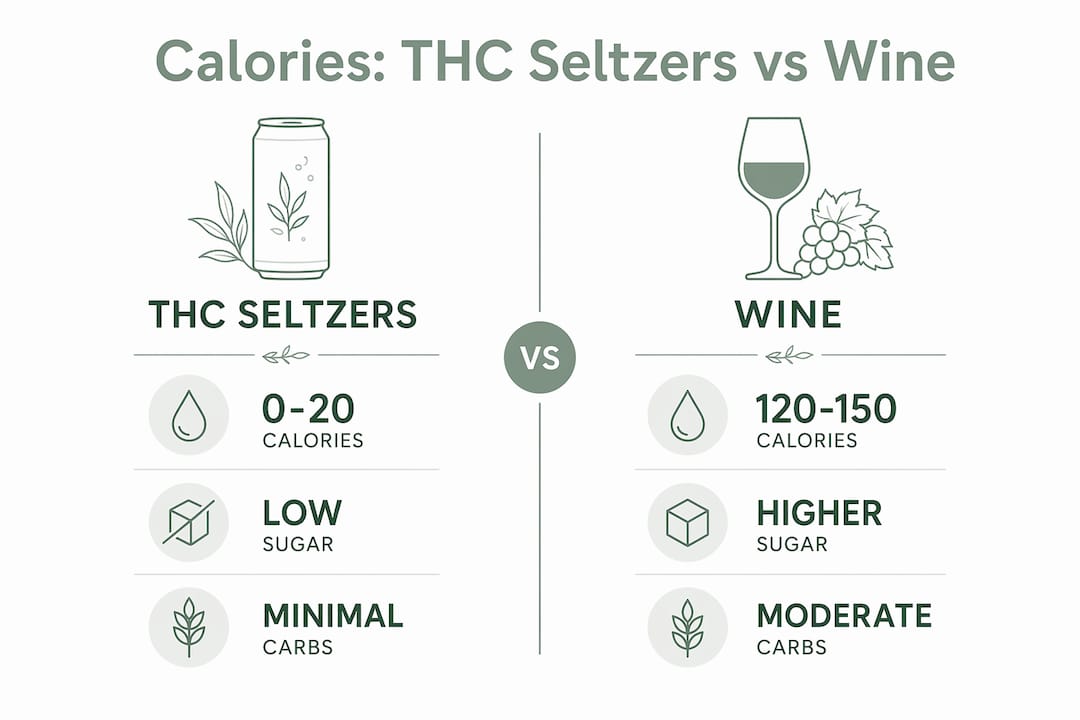
The numbers tell a clear story. Most quality THC seltzers contain 0 to 20 calories per serving, with many products sitting at 0 to 5 calories and zero added sugar. A standard 5-ounce pour of wine lands between 120 and 150 calories, depending on the variety. A dry red like Cabernet Sauvignon sits near the top of that range, while a light white like Pinot Grigio comes in slightly lower, but neither comes close to the calorie profile of a THC seltzer.
The reason for this gap is straightforward. Alcohol delivers 7 calories per gram, and those calories are metabolically empty. They provide no protein, no fiber, and no micronutrients. A typical 5-ounce glass of wine contains roughly 14 grams of alcohol, which accounts for the majority of its calorie count before you even factor in residual sugars. THC, on the other hand, is dosed in milligrams (typically 5 to 10 mg per serving) and contributes negligible calories. The calories in THC seltzers come almost entirely from any added flavoring or sweeteners, which quality producers keep minimal.
Here is a practical side-by-side look at the caloric comparison:
| Beverage | Serving Size | Calories | Sugar | Carbs |
|---|---|---|---|---|
| Tryfloral THC Seltzer | 12 oz can | 0 | 0g | 0g |
| Average THC seltzer | 12 oz can | 0 to 20 | 0 to 3g | 0 to 5g |
| Pinot Grigio | 5 oz glass | 120 | 1.5g | 3g |
| Cabernet Sauvignon | 5 oz glass | 130 | 0.9g | 4g |
| Moscato | 5 oz glass | 150 | 7g | 14g |
The table above makes the caloric comparison between THC seltzers and wine concrete. A sweeter wine like Moscato stacks sugar calories on top of alcohol calories, pushing the total even higher. THC seltzers, particularly zero-sugar options, sit in a completely different category nutritionally.
Pro Tip: Check the nutrition label on any THC seltzer before buying. Some flavored options add cane sugar or fruit juice, which can push calories up to 80 to 100 per can. True zero-calorie products use natural flavoring without added sweeteners.
How do THC seltzers and wine affect your metabolism and sleep?
Calories are only part of the picture. Where you feel the real difference between wine and THC seltzers is in how your body processes each one overnight and the next morning.
Alcohol disrupts REM sleep and spikes cortisol, the stress hormone that rises when your body is working to metabolize ethanol. Even two glasses of wine can fragment your sleep cycles, leaving you groggy and less recovered the next day. That cortisol spike also has metabolic consequences. Elevated cortisol promotes fat storage, particularly around the midsection, which means the caloric impact of wine extends beyond the calories you consume in the glass.
Low-dose THC works through the endocannabinoid system, a network of receptors that regulates mood, appetite, and relaxation. Unlike alcohol, low-dose THC supports relaxation without suppressing REM sleep or triggering cortisol spikes. You wind down, you sleep through your normal cycles, and you wake up without the metabolic debt that wine creates.
“The calm, relaxing feeling sought from wine can be achieved more effectively with low-dose THC without the metabolic or sleep disruption costs.” — Equilibria
Many adults switching from wine to THC seltzers report better sleep quality as one of the first changes they notice, often within the first week. That improvement is not just about feeling rested. Better REM sleep supports hormone regulation, appetite control, and cognitive function, all of which connect back to long-term weight management.
Pro Tip: If you are new to THC beverages, start with a 2.5 mg to 5 mg dose and give it 15 to 20 minutes before deciding whether to have more. The onset time for THC seltzers is 15 to 20 minutes, which is faster than edibles but still requires patience.
What does switching from wine to THC seltzers mean for your calorie intake?
The aggregate math is where this comparison gets genuinely motivating. Consider a moderate social drinker who has three to four glasses of wine per week. That habit adds up to 400 to 1,000 empty calories weekly, depending on the wine and pour size.
Replacing those glasses with THC seltzers could prevent 6 to 14 pounds of body fat accumulation per year, based on the calorie differential alone. That estimate assumes no other dietary changes, which makes it a realistic and conservative projection for anyone making a direct swap. For social drinkers mindful of calories, replacing alcohol with THC beverages can eliminate tens of thousands of empty calories annually.
Here is what that looks like in practice across a year:
- Weekly savings: Swapping 3 glasses of Cabernet (390 calories) for 3 Tryfloral THC seltzers (0 calories) saves roughly 390 calories per week.
- Monthly savings: That compounds to approximately 1,560 calories saved per month without changing anything else about your diet.
- Annual savings: Over 52 weeks, you eliminate roughly 20,000 calories from your intake, the equivalent of about 5 to 6 pounds of body fat.
- Bonus effect: You also remove the cortisol and sleep disruption costs that compound the metabolic impact of regular wine consumption.
Many women switching from wine to THC seltzers cite better sleep, fewer calories, and fewer next-day effects as their primary motivators, rather than choosing complete sobriety. This is a meaningful distinction. THC seltzers are not a wellness sacrifice. They are a lateral move that delivers the social ritual with a fraction of the caloric and metabolic cost.
How do cost and experience compare between THC seltzers and wine?
Beyond the calorie count, practical factors like price, onset, and social feel matter when you are deciding what to reach for at a gathering.
On cost, the gap is smaller than most people expect. THC seltzers typically cost $5 to $8 per can, while a glass of mid-range wine at a restaurant runs $4 to $7. At retail, a bottle of decent wine costs $12 to $20, which works out to a similar per-serving price. The cost difference is not a major barrier, especially when you factor in that one THC seltzer often delivers a satisfying experience without the urge to have a second or third.
On experience, here is what you can expect from each:
- Onset time: THC seltzers kick in within 15 to 20 minutes. Wine’s effects are felt within 5 to 10 minutes but build less predictably depending on food intake and body weight.
- Duration: THC seltzer effects last 3 to 4 hours, similar to a moderate wine session, but without the energy crash at the end.
- Next-day feel: THC beverages carry no hangover and no liver toxicity. Wine, even in moderate amounts, can cause dehydration, headaches, and disrupted sleep.
- Social ritual: Both beverages work well in social settings. THC seltzers come in flavors like tropical, harvest apple, and strawberry mango, which makes them easy to enjoy at parties, dinners, or casual evenings at home.
- Calorie-free options: Zero-calorie THC seltzers are competitive with flavored sparkling waters on nutrition, which means you can sip freely without tracking.
The social experience of THC seltzers is genuinely comparable to wine for most adults. You get a mild, pleasant buzz, a flavorful drink in your hand, and a relaxed atmosphere. You skip the empty calories, the disrupted sleep, and the next-morning fog. For anyone switching from alcohol to THC drinks, the transition tends to be smoother than expected.
Key takeaways
THC seltzers contain 0 to 20 calories per serving compared to 120 to 150 calories in a glass of wine, making them the lower-calorie choice for social drinkers by a wide margin.
| Point | Details |
|---|---|
| Calorie gap is significant | THC seltzers have 0 to 20 calories per can versus 120 to 150 calories per glass of wine. |
| Alcohol drives wine’s calories | At 7 calories per gram, alcohol accounts for most of wine’s caloric load, not sugar. |
| Sleep and metabolism benefit | Low-dose THC does not suppress REM sleep or spike cortisol the way alcohol does. |
| Annual savings add up fast | Swapping 3 to 4 weekly wine glasses for THC seltzers can prevent 6 to 14 pounds of fat gain per year. |
| Cost is roughly comparable | THC seltzers run $5 to $8 per can, similar to a glass of mid-range wine at retail. |
Why I think the calorie conversation undersells THC seltzers
I have spent a lot of time looking at how adults make beverage choices in social settings, and the calorie comparison between THC seltzers and wine is genuinely compelling. But I think it undersells the full case.
The real advantage is not just the number on the nutrition label. It is the absence of the downstream costs that wine quietly accumulates. Fragmented sleep, elevated cortisol, next-day brain fog, and the metabolic drag of regular alcohol consumption are costs that most people accept as normal because they are spread out over time. They do not show up on a nutrition label.
When you pick up a zero-calorie THC seltzer instead of a glass of Cabernet, you are not just saving 130 calories. You are opting out of a metabolic cycle that compounds over weeks and months. That is the part worth paying attention to. The calorie math is the easy argument. The sleep and recovery argument is the one that actually changes how you feel.
My honest recommendation: try the swap for two weeks. Keep everything else the same. Pay attention to how you sleep and how you feel in the morning. The calorie difference will show up on the scale eventually, but the sleep improvement tends to show up first, and that is what convinces most people to stick with it.
— Adam
Try Tryfloral’s zero-calorie THC seltzers
If you are ready to make the switch, Tryfloral makes it easy. Every can in the Tryfloral lineup is zero calories, zero sugar, and crafted with a farm-to-fridge approach that prioritizes quality from source to shelf.
Flavors like Harvest Apple, Tropical, and Strawberry Mango give you something genuinely enjoyable to sip at any social occasion, without the caloric trade-off that comes with wine. Each can delivers a consistent 5 mg dose designed for a mild, relaxed buzz. Learn more about what makes Tryfloral different by exploring the farm-to-fridge difference and see the full range of Tryfloral THC seltzers available now. Please enjoy responsibly. You must be 21 or older to purchase.
FAQ
How many calories are in a THC seltzer vs a glass of wine?
Most THC seltzers contain 0 to 20 calories per can, while a standard 5-ounce glass of wine contains 120 to 150 calories. Zero-calorie options like Tryfloral contain no sugar and no alcohol-derived calories.
Are THC seltzers a healthier option than wine?
For calorie-conscious adults, THC seltzers offer fewer calories, no hangover, and no REM sleep disruption compared to wine. They are not a medical product, but the nutritional and metabolic profile is significantly cleaner than alcohol.
How long does it take for a THC seltzer to kick in?
THC seltzers typically take 15 to 20 minutes to take effect, with the experience lasting 3 to 4 hours. This is faster than traditional edibles because the liquid format speeds absorption.
Can switching from wine to THC seltzers help with weight management?
Replacing 3 to 4 weekly glasses of wine with THC seltzers can reduce your weekly intake by 400 to 1,000 empty calories, which translates to a potential reduction of 6 to 14 pounds of body fat per year.
Do THC seltzers have sugar or carbs?
Many quality THC seltzers, including those from Tryfloral, contain zero sugar and zero carbohydrates. Some flavored options on the market do add fruit juice or cane sugar, so checking the THC seltzer nutrition facts label before purchasing is always a good habit.
