

Indiana adults shopping for THC beverages are navigating two layers of law at once. The 2018 Farm Bill set the federal baseline by defining hemp as cannabis containing no more than 0.3% delta-9 THC on a dry weight basis, making hemp-derived products federally legal for the first time. But that definition left a gap, and delta-8 THC products flooded the market through a loophole the federal law never addressed. Indiana’s 2026 Senate Bill 250 closes that gap directly, shifting the state from a definitions-only approach to full product governance.
Here is what that means for you in plain terms:
- The Farm Bill’s delta-9 THC limit defines hemp federally but does not regulate all cannabinoids
- Delta-8 THC and similar compounds existed in a legal gray zone under federal law
- Indiana’s SB 250, effective October 1, 2026, expands the state’s THC definition to cover hemp-derived cannabinoids, synthetic equivalents, and isomers
- Mandatory permits are now required for manufacturers, distributors, retailers, and carriers, with fees set by the state
- Products must pass testing and carry a certificate of analysis
- Sales to anyone under 21 are prohibited, with penalties ranging from Class C misdemeanor to level 6 felony depending on violations involving minors and harm caused.
- A Hemp Derived Cannabinoid Products Fund finances enforcement through state and local agencies
Table of Contents
- How the 2018 Farm Bill shapes THC regulation in Indiana
- Indiana’s SB 250 closes the loopholes the Farm Bill left open
- What Indiana adults should know before buying THC beverages
- How Tryfloral fits into Indiana’s regulated THC beverage market
- Tryfloral: compliant THC seltzers made for Indiana adults
- Key Takeaways
How the 2018 Farm Bill shapes THC regulation in Indiana
The Agriculture Improvement Act of 2018 did something genuinely significant: it removed hemp from the federal Controlled Substances Act and handed regulatory oversight to the USDA. States and tribes could submit their own hemp production plans, provided those plans included testing and licensing procedures aligned with federal standards.
For Indiana farmers and producers, the practical benefits were real. Hemp became eligible for federal crop insurance and USDA research programs, giving hemp farming a legitimate agricultural footing alongside corn and soybeans.
The Farm Bill’s limits, though, matter just as much as its permissions:
- Legality hinges entirely on delta-9 THC concentration, not total cannabinoid content
- Delta-8 THC, delta-10 THC, and synthetic isomers were never explicitly addressed
- FDA retained full authority over hemp-derived consumables, including THC beverages, separate from USDA rules
- Interstate commerce protections apply to compliant hemp, but state laws can still restrict products locally
That FDA carve-out is worth understanding. The Farm Bill did not give hemp-derived food and beverage products a free pass. FDA’s authority under the Federal Food, Drug, and Cosmetic Act remained intact, meaning THC beverages occupy a space where both federal agencies and state regulators have a say. Indiana’s 2026 legislation fills exactly that regulatory space at the state level.
Indiana’s SB 250 closes the loopholes the Farm Bill left open
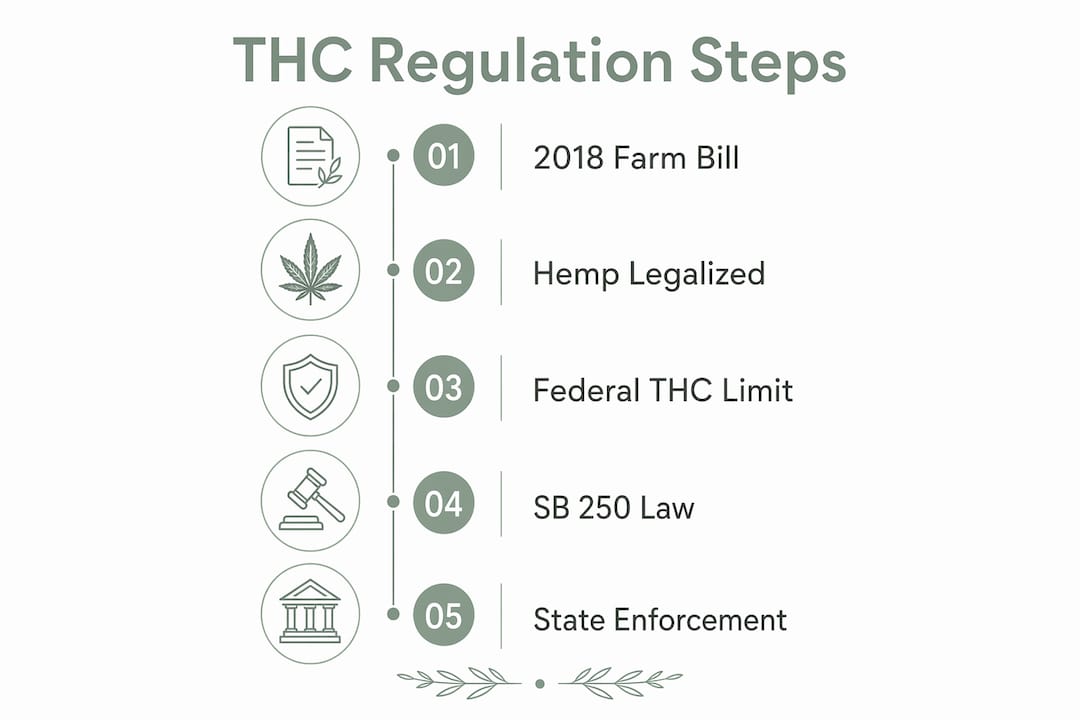
The delta-8 loophole was straightforward to exploit: because federal law defined legality only by delta-9 THC concentration, products made from hemp-derived delta-8 THC were widely sold with minimal oversight. Indiana’s SB 250 ends that era.

Effective October 1, 2026, the bill redefines THC under Indiana law to include hemp-derived cannabinoid products, synthetic equivalents, and isomers with similar chemical structure and pharmacological activity. That single definitional change sweeps delta-8 and related compounds into the regulated category.
The permit structure SB 250 creates is thorough:
- Manufacturer permit: $1,000, requires a permanent facility and licensed hemp sourcing
- Distributor permit: $750, with a 5% excise tax on wholesale price remitted to the Alcohol and Tobacco Commission (ATC)
- Retail permit: $550, with advertising restrictions and age-verification requirements
- Carrier permit: $250, with a minimum $5,000 surety bond
Senator Freeman, the bill’s primary sponsor, stated the motivation plainly: certainty and youth protection. The Hemp Derived Cannabinoid Products Fund, financed by permit fees and the excise tax, distributes significant portions to ATC administration, law enforcement programs, mental health crisis services, and the state general fund. Selling a hemp-derived cannabinoid product to someone under 21 is a misdemeanor under Indiana law, with more severe penalties possible if serious harm results.
Indiana also bans online sales of hemp-derived cannabinoid products entirely, a provision that directly affects consumers who previously ordered THC beverages from out-of-state websites.
What Indiana adults should know before buying THC beverages
The shift to product governance changes what you should look for when buying a THC beverage in Indiana. “Hemp-derived” on a label no longer signals automatic legality. Under SB 250, a product that violates the new rules is treated as marijuana under Indiana criminal law, regardless of its delta-9 THC percentage.
Here is a practical checklist for buying THC beverages responsibly in Indiana after October 1, 2026:
- Valid retail permit: The seller must hold a current ATC-issued permit
- Certificate of analysis (COA): Required by law; it confirms THC content and purity
- Age verification: You must be 21 or older; retailers face serious penalties for non-compliance
- No online purchases: Indiana prohibits online sales of hemp-derived cannabinoid products
- Milligram limits: Check per-container THC milligram limits as product governance rules take effect
- Smokable hemp: Indiana maintains its ban on smokable hemp, which predates SB 250
Understanding the difference between CBD and THC also helps you read labels accurately and make choices that match what you are actually looking for in a beverage.
Pro Tip: Before you buy, ask to see the product’s certificate of analysis. A legitimate retailer operating under Indiana’s 2026 rules will have it on hand or accessible via QR code on the packaging. If they cannot produce one, that is a clear sign to walk away.
The 0.3% THC limit that the Farm Bill established is still the federal baseline, but Indiana’s state rules now layer additional requirements on top of it. Knowing both sets of rules protects you legally and helps you find products that are genuinely safe and compliant.
How Tryfloral fits into Indiana’s regulated THC beverage market
Tryfloral operates as a farm-to-fridge THC beverage brand built around exactly the kind of compliance Indiana’s 2026 regulations demand. From sourcing hemp through licensed Indiana growers to producing beverages that meet testing and labeling requirements, every step in the process is designed to hold up under the new regulatory framework.
Tryfloral’s blog covers the practical questions Indiana adults are actually asking, from delta-9 seltzer specifics under the 2026 rules to where to find legal THC drinks in Indianapolis. That consumer education focus reflects a genuine commitment to helping you make informed, legal choices, not just selling a product.
The beverages themselves, including seltzers crafted for a mild, social buzz, are formulated to comply with federal hemp definitions and Indiana’s evolving state standards. Tryfloral tracks regulatory changes so you do not have to, and every product is backed by testing documentation aligned with SB 250’s certificate of analysis requirements.
Tryfloral: compliant THC seltzers made for Indiana adults
Tryfloral’s farm-to-fridge process means you get a THC beverage that starts with licensed Indiana hemp and ends in your fridge fully tested, labeled, and compliant with the 2026 regulatory environment. No guesswork about sourcing, no missing lab results, no unlicensed sellers.
The Harvest Apple THC Seltzer and Tropical THC Seltzer are zero-calorie options built for adults who want a clean, enjoyable experience without the hangover. They are exactly the kind of product SB 250 was designed to support: tested, permitted, and age-gated. Browse the full lineup at tryfloral.com and enjoy responsibly.
Key Takeaways
Indiana’s 2026 SB 250 transforms THC regulation from a federal definition baseline into a full state product-governance system, requiring permits, testing, and age verification for all hemp-derived cannabinoid products.
| Point | Details |
|---|---|
| Farm Bill’s federal baseline | Defines hemp as ≤0.3% delta-9 THC dry weight; does not regulate delta-8 or synthetic cannabinoids. |
| Delta-8 loophole closed | SB 250 expands Indiana’s THC definition to include hemp-derived cannabinoids, synthetics, and isomers. |
| Permit and testing requirements | Manufacturers ($1,000), distributors ($750), retailers ($550), and carriers ($250) all require ATC permits. |
| Age restriction and online ban | Sales to anyone under 21 are a Class A misdemeanor; online sales of hemp-derived products are prohibited in Indiana. |
| Tryfloral compliance | Tryfloral sources from licensed Indiana hemp growers and provides COA-backed, fully tested THC seltzers under the 2026 rules. |
