

If you’ve picked up a hemp product in Indiana lately and wondered whether it’s actually legal, you’re not alone. The role of 0.3 percent THC limit in Indiana is one of the most misunderstood pieces of cannabis law in the state. A lot of adults assume the number is simple: stay under 0.3% and you’re fine. The reality is more layered than that, especially with new legislation taking effect in 2026 that changes how that percentage gets calculated. This guide breaks it all down plainly so you know exactly where you stand.
For the up-to-date bottom line — is Delta-9 legal in Indiana? — see our Indiana legality page; this post covers the science behind the 0.3% number.
Table of Contents
- Key Takeaways
- How Indiana law defines hemp vs. marijuana
- Delta-9 THC vs. total THC: why the difference matters
- Indiana’s compliance system for hemp THC products
- Practical tips for Indiana consumers buying THC products
- My take on where Indiana’s THC rules are heading
- Try a compliant THC beverage from Tryfloral
- FAQ
Key Takeaways
| Point | Details |
|---|---|
| 0.3% is the legal threshold | Hemp products must stay at or below 0.3% THC by dry weight to avoid controlled substance classification in Indiana. |
| Total THC now counts | New rules count delta-9 THC plus THCA together, not just delta-9 alone, raising compliance complexity. |
| Permits and testing apply | Indiana requires testing, labeling, and supply chain permits for all hemp-derived cannabinoid products sold legally. |
| Low-dose products can still impair | Products under 0.3% THC can produce psychoactive effects, especially with regular or higher-volume use. |
| Drug tests can detect trace use | Metabolites from legal THC products can accumulate and trigger positive urine drug test results over time. |
How Indiana law defines hemp vs. marijuana
The single number that separates legal hemp from illegal marijuana in Indiana is 0.3% THC by dry weight. Cross that line and a product shifts from a legal hemp commodity to a controlled substance classification. That distinction has enormous consequences for manufacturers, retailers, and everyday consumers.
Indiana’s definition of hemp mirrors the federal framework established by the 2018 Farm Bill. Both draw the line at 0.3% delta-9 THC on a dry-weight basis. For years, that meant testing only for delta-9 THC, which allowed some high-THCA flower products to pass legally because their delta-9 content technically stayed below the threshold.
| Category | THC Level | Legal Status in Indiana |
|---|---|---|
| Hemp | Up to 0.3% THC (dry weight) | Legal |
| Hemp (exceeds limit) | Above 0.3% THC | Treated as marijuana |
| Marijuana | Any amount above threshold | Controlled substance |
| Hemp-derived delta-9 beverages | Below 0.3% THC by dry weight | Legal with proper permits |
Indiana Senate Bill 250 is designed to close that gap. The bill mirrors federal total THC restrictions and is set to take effect in July 2026, counting all forms of THC toward the 0.3% cap. Legislative intent here is direct: prevent intoxicating hemp products from bypassing marijuana laws through technical loopholes.
Pro Tip: When you shop for hemp products in Indiana, look for a certificate of analysis (COA) from a third-party lab. That document should show total THC, not just delta-9, so you know a product is genuinely compliant under the newer rules.
Delta-9 THC vs. total THC: why the difference matters
This is where a lot of consumers get tripped up. Delta-9 THC is the specific cannabinoid molecule that produces psychoactive effects when it binds to receptors in your brain. Total THC includes delta-9 plus THCA, which is a non-psychoactive precursor found naturally in raw cannabis.
Here’s the catch. THCA converts to delta-9 THC when exposed to heat, a process called decarboxylation. So a product that tests at 0.1% delta-9 THC could still contain 2% THCA. Light it up or bake it into an edible and that THCA turns into active delta-9 THC, making the product far more potent than the label suggested.
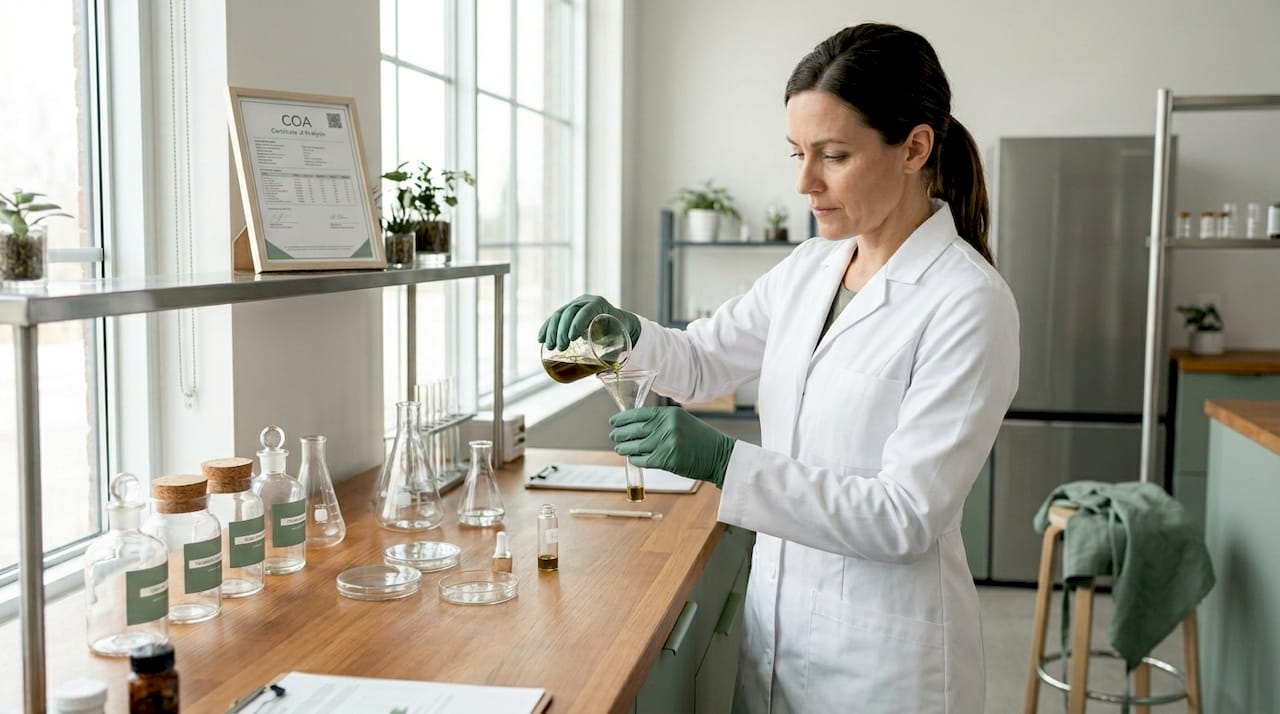
Under the old delta-9-only standard, this was a compliance gray area that some producers exploited. The federal redefinition of hemp adopted in 2025 now counts delta-9 THC plus THCA together toward the 0.3% total THC cap. Indiana’s 2026 legislation aligns with that standard.
What this means practically for you:
- A product showing 0.28% delta-9 THC on its label is not automatically compliant if it carries significant THCA content that pushes total THC over 0.3%.
- Hemp flower products are especially affected because raw flower can carry high THCA loads.
- Beverages and infused products formulated with hemp-derived delta-9 distillate tend to have lower THCA levels, making total THC compliance easier to verify.
- Legal THC drinks in Indiana generally use hemp-derived delta-9 that has already been processed to reduce precursor cannabinoids, putting total THC compliance more firmly within reach.
Pro Tip: Ask brands directly whether their COA reports total THC or delta-9 only. If a company can’t answer that question quickly and clearly, that’s a signal to shop elsewhere.
Indiana’s compliance system for hemp THC products
Indiana doesn’t just set a number and walk away. The state has built a layered enforcement system around hemp-derived cannabinoid products that every participant in the supply chain must follow. Understanding that system helps you spot legitimate products and avoid legal risk.
Here’s how the compliance framework is structured:
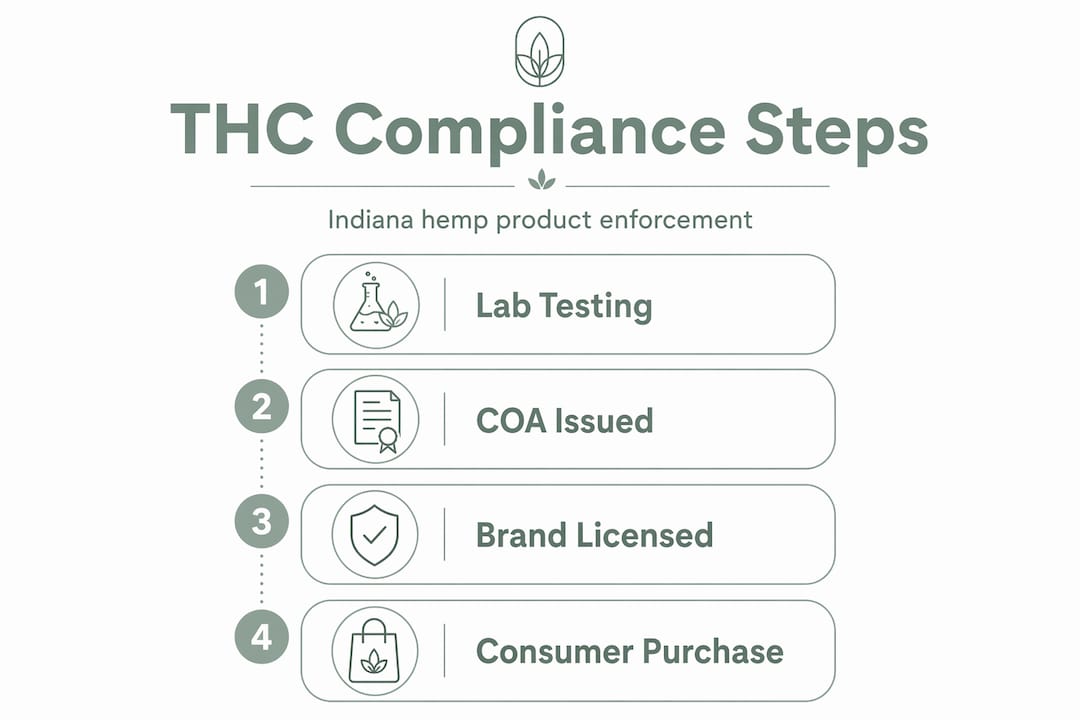
- Testing authority. State regulators have spot-testing authority over hemp products at any point in the supply chain. Products that test over the THC threshold can be seized and destroyed, and sellers face criminal penalties under the 2026 hemp-derived cannabinoid law.
- Labeling requirements. Products must carry accurate THC content disclosures, batch numbers, and manufacturer information. Proper packaging and labeling compliance is not optional. Missing or misleading labels are a separate violation from THC content issues.
- Permit requirements. Manufacturers, distributors, retailers, and carriers all need permits. If any party in the supply chain operates without one, products can be treated as marijuana regardless of THC content.
- Per-container THC caps. Beyond percentage limits, federal per-container milligram caps may make some popular hemp edibles and drinks non-compliant even if they test under 0.3% by dry weight.
- Age restrictions. Retail establishments where 85% or more of sales are THC products restrict under-21 access, similar to alcohol retailers.
Indiana’s layered enforcement system creates real accountability at every step. Buying from a licensed, permitted brand is not just the safe choice. It is the only choice that gives you any confidence about what you’re actually consuming.
Practical tips for Indiana consumers buying THC products
Knowing what legal THC looks like in Indiana helps you make smarter decisions at the store or online. The products you’ll typically find are hemp-derived delta-9 gummies, tinctures, and beverages. All of them are formulated to stay at or below 0.3% THC by dry weight.
Here’s what you need to watch for as a buyer:
- Read the COA carefully. Check that total THC, not just delta-9, stays at or below 0.3% by dry weight. Look for the test date and confirm it was done by an accredited third-party lab.
- Watch your serving sizes. Hemp-derived delta-9 products below 0.3% can still produce psychoactive effects, especially at higher doses. A single beverage might be fine; three of them in one evening is a different experience.
- Understand the drug test risk. If you use THC products regularly, even below the legal limit, urine tests can detect THC metabolites that accumulate over time. This is a real employment and legal risk for many Indiana adults.
- Buy from permitted retailers. Products sold outside the licensed supply chain carry no guarantee of accurate labeling, correct THC levels, or safe ingredients.
- Check for age-gating. Legitimate retailers will verify your age before selling THC products. If a retailer skips that step, walk away.
Pro Tip: For a low-calorie, controlled-dose option, THC beverages can be easier to manage than gummies because the serving size is clear and the onset time is relatively predictable. Check out this guide to responsible THC beverage consumption for more tips on enjoying them safely.
My take on where Indiana’s THC rules are heading
I’ve followed cannabis regulation closely for years, and what’s happening in Indiana right now is one of the more significant shifts I’ve seen in hemp law. The move from delta-9-only counting to total THC is not a minor tweak. It fundamentally changes which products can exist in the legal market.
What I’ve seen again and again is that consumers treat “legal hemp” as a blanket guarantee of safety and low potency. It isn’t. A product can be fully compliant today and produce a noticeable buzz, especially if you’re having multiple servings or using it daily. That’s not a flaw in the law. It’s just the reality of how cannabinoids work at even low concentrations.
What concerns me more is the enforcement gap. Indiana’s permit system is solid on paper, but the gray market for unregulated hemp products is still active. I’d encourage any adult in Indiana to take brand transparency seriously. Ask who manufactured the product, demand a current COA, and don’t assume that a hemp label alone means everything is above board.
The regulatory direction is clearly toward tighter controls and closer federal-state alignment. Brands and consumers who stay ahead of that curve now will face far fewer surprises when the next round of changes lands.
— Adam
Try a compliant THC beverage from Tryfloral
If you want to enjoy a legal THC product in Indiana without worrying about whether it meets the state’s standards, Tryfloral makes that straightforward. As a farm-to-fridge THC beverage brand, Tryfloral formulates every product to comply with Indiana’s 0.3% THC dry-weight limit, with full third-party lab testing and clear labeling on every can.
The Harvest Apple THC Seltzer is zero calories, lightly carbonated, and built for a relaxed social experience. It delivers a mild, controlled buzz without the hangover you’d get from alcohol. It’s the kind of drink you can feel good about sharing with friends, stored right in your fridge and ready when you are. Every batch is crafted with clean ingredients and tested so you know exactly what you’re getting. Explore Tryfloral’s full lineup at tryfloral.com and find your new go-to for a responsible good time.
FAQ
What is the 0.3% THC limit in Indiana?
The 0.3% THC limit defines the maximum THC concentration a product can contain to be classified as legal hemp rather than marijuana in Indiana. Products exceeding this threshold are treated as controlled substances under state law.
What is hemp-derived delta-9 THC in Indiana?
Hemp-derived delta-9 THC refers to delta-9 tetrahydrocannabinol extracted from hemp plants that contain no more than 0.3% total THC by dry weight. These products are legal in Indiana when sold through a properly permitted supply chain.
Does legal THC in Indiana still get you high?
Yes. Hemp-derived delta-9 products below the 0.3% threshold can still produce psychoactive effects, particularly at higher serving sizes or with frequent use. Legal does not mean non-intoxicating.
Can you fail a drug test using legal THC products in Indiana?
Yes. Regular use of products containing even trace amounts of THC can cause metabolite buildup, and urine tests can return positive results even when only legal hemp products were consumed. Use caution if workplace drug testing applies to you.
How does total THC differ from delta-9 THC under Indiana law?
Total THC includes both delta-9 THC and THCA, a precursor that converts to psychoactive delta-9 when heated. Indiana’s 2026 legislation counts both forms together toward the 0.3% cap, closing a loophole that previously allowed high-THCA products to pass as legal.
Recommended
- Legal THC drinks Indiana: low-calorie, hangover-free picks – Floral Beverages
- How to identify clean cannabis beverage ingredients – Floral Beverages
- Smart guide to THC drinks: Enjoy without the hangover – Floral Beverages
- Non-Alcoholic Networking Drinks Explained for Modern Events – Floral Beverages
