

Cross-tolerance between alcohol and cannabis is defined as the condition where regular use of one substance reduces the effects of the other. The science is clear: this does not reliably occur between alcohol and cannabis. These two substances act on entirely different receptor systems in the brain, so building tolerance to one offers no meaningful protection against the other. What actually happens when you combine them is the opposite of protection. The cannabis alcohol interaction produces synergistic impairment, meaning the combined effect is greater than either substance alone. Understanding cross tolerance alcohol cannabis explained correctly could change how you approach your next social gathering.
What is cross-tolerance and why doesn’t it develop between alcohol and cannabis?
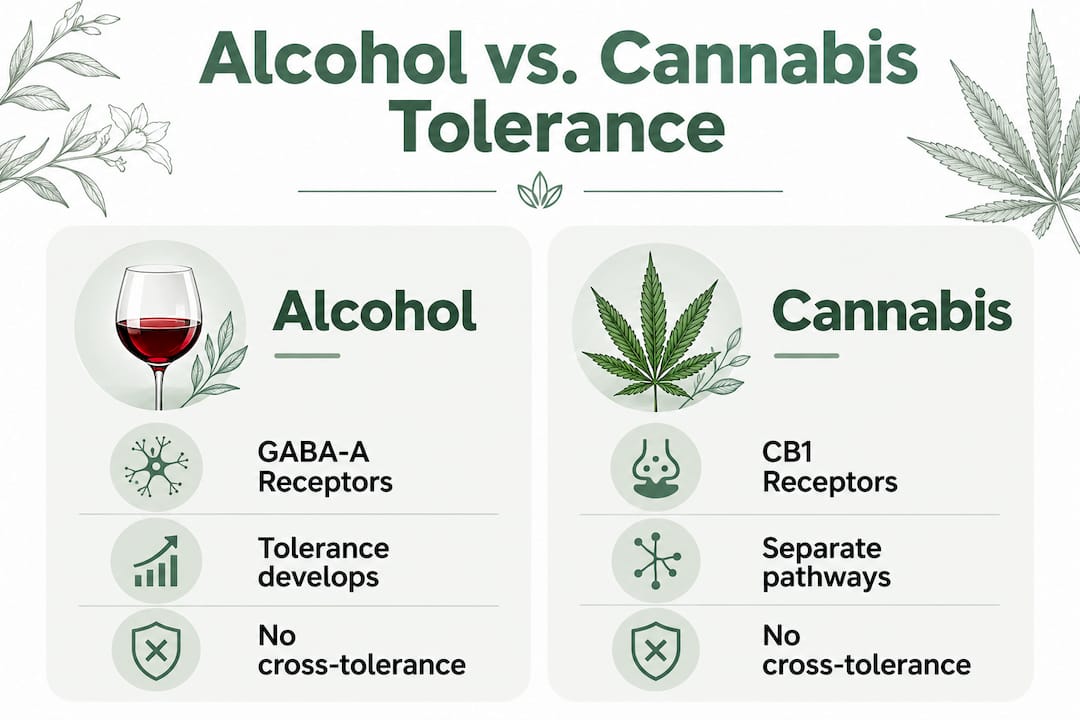
Cross-tolerance requires shared receptor mechanisms to develop between two substances. When two drugs act on the same receptors, the body’s adaptation to one naturally reduces sensitivity to the other. Alcohol and cannabis do not share this overlap.
Alcohol primarily acts on GABA-A receptors, which slow brain activity, and on glutamate receptors, which normally excite it. Cannabis acts on CB1 and CB2 cannabinoid receptors, which are part of the endocannabinoid system. These are distinct neurochemical pathways, and the body adapts to each one independently.
Here is what this means practically:
- Drinking heavily for years builds tolerance to alcohol’s sedative effects via GABA-A receptor adaptation.
- Regular cannabis use causes CB1 receptor downregulation, which reverses within days to weeks of stopping.
- Neither process affects the other’s receptor system.
- Tolerance to cannabis is cannabinoid-specific and involves no crossover from alcohol use.
- Assuming your alcohol tolerance protects you from a strong cannabis dose is a common and risky mistake.
Pro Tip: If you are a regular drinker trying cannabis for the first time in a social setting, treat your alcohol tolerance as completely irrelevant. Your CB1 receptors have no memory of your bar tab.
The distinction between cross-tolerance and cross-effects matters here. Cross-effects describe how two substances influence each other’s impact when taken together. That interaction is very real between alcohol and cannabis, but it amplifies impairment rather than reducing it.
How do alcohol and cannabis interact to intensify impairment?
The cannabis alcohol interaction does not produce a balanced, manageable buzz. It produces compounded impairment through two separate mechanisms: pharmacokinetic and pharmacodynamic.
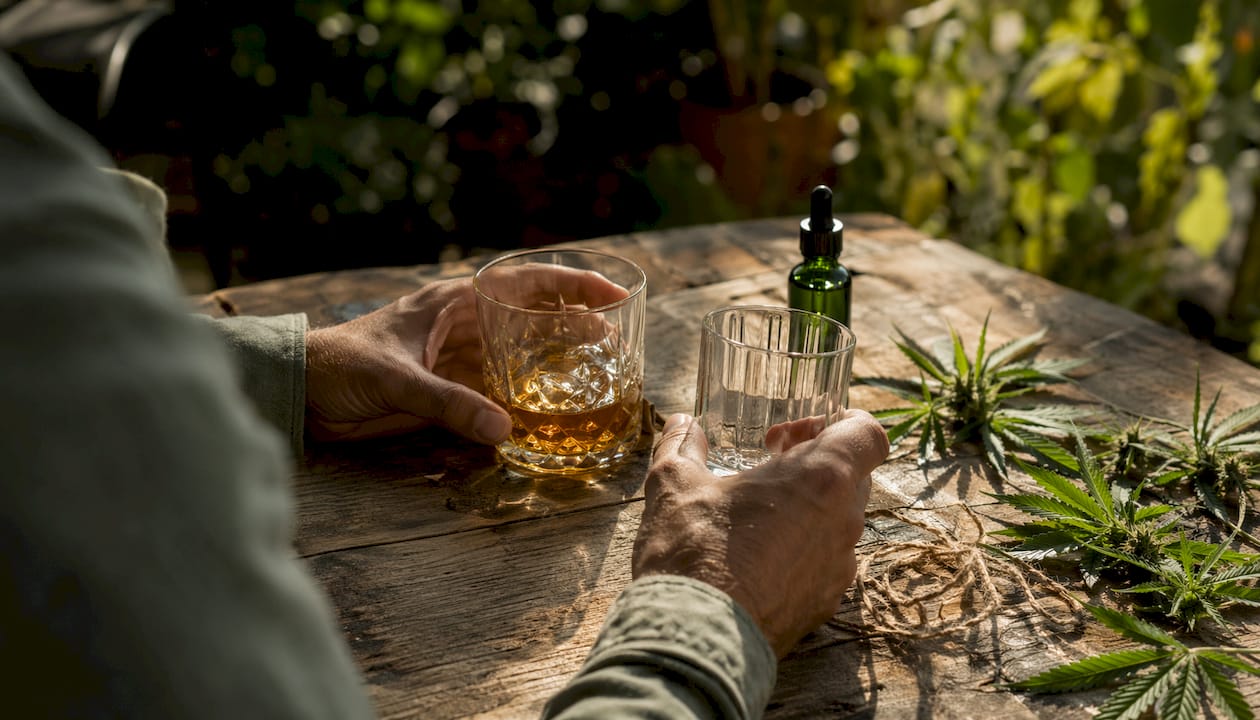
The pharmacokinetic effect is the more surprising one. Alcohol’s vasodilating effect elevates THC blood levels, meaning alcohol widens blood vessels and speeds THC absorption into the bloodstream. Drinking before using cannabis can push your peak THC concentration significantly higher than cannabis alone would. That translates directly into stronger psychoactive effects and a greater risk of what users call a “greenout,” which involves dizziness, nausea, sweating, and anxiety.
The pharmacodynamic effect compounds this further. Both substances depress the central nervous system, and their overlapping influence on brain circuits produces impairment that exceeds what either would cause alone. Coordination, reaction time, and judgment all suffer more than users typically expect.
The order of use matters significantly:
- Alcohol first, then cannabis: Alcohol raises THC absorption, intensifies the high, and increases greenout risk.
- Cannabis first, then alcohol: Cannabis-first use delays alcohol’s onset, which can cause you to drink more before feeling the full effect, leading to overconsumption.
- Simultaneous use: Both mechanisms activate at once, producing the least predictable outcome.
- Edibles with alcohol: Edibles have a delayed onset of up to two hours. Drinking while waiting for edibles to kick in is a well-documented path to severe overconsumption.
“Alcohol before cannabis increases 11-hydroxy-THC, the more potent psychedelic metabolite, extending and intensifying the high beyond what most users anticipate.”
One additional risk deserves attention. Cannabis masks the body’s emetic response to alcohol, meaning it suppresses the nausea that would normally signal you to stop drinking. That natural warning system disappears, raising the risk of alcohol poisoning. This is not a minor side effect. It is a physiological change that removes one of your body’s key safety mechanisms.
What does current research reveal about combined use and impairment?
The research on combined alcohol and cannabis use is consistent and concerning. A 2026 study published in JAMA Network Open through Johns Hopkins Medicine found that co-use of cannabis edibles and alcohol produces greater and longer-lasting driving impairment than either substance alone. The findings showed that driving impairment at a breath alcohol concentration of 0.05% with combined use matched or exceeded impairment at 0.08% BrAC with alcohol alone. That is a critical finding. It means you can be below the legal alcohol limit and still be as impaired as someone who is legally drunk, simply because cannabis is also in your system.
The same research exposed a serious detection gap. Standard field sobriety tests failed to reliably identify impairment in participants who had used both substances. People showed significant driving impairment but tested negative on standard assessments. Law enforcement tools built for alcohol alone are not calibrated for combined impairment.
| Scenario | Impairment level | Detection risk |
|---|---|---|
| Alcohol alone at 0.08% BrAC | High | Detectable by standard tests |
| Cannabis edibles alone | Moderate to high | Poorly detected by standard tests |
| Combined use at 0.05% BrAC | Matches or exceeds 0.08% alcohol alone | Often missed by standard tests |
| Edibles plus alcohol (delayed onset) | Severe and unpredictable | Very difficult to detect |
Cannabis and alcohol interactions are synergistic, not simply additive. That distinction matters for public health messaging. Telling people to “be careful” when combining substances understates the actual risk. The impairment is disproportionately greater than most people expect, and the tools designed to catch it are not keeping up. For a deeper look at how THC affects driving specifically, the Tryfloral guide on THC drinks and driving covers the research in practical terms.
How should adults approach combined use in social settings?
The absence of cross-tolerance means you cannot rely on your experience with one substance to predict your response to both. Practical harm reduction starts with accepting that reality.
- Do not assume tolerance transfers. Your alcohol tolerance does not protect your CB1 receptors. Your cannabis tolerance does not buffer alcohol’s GABA-A effects. These are separate systems.
- Prefer cannabis before alcohol if combining. Using cannabis before alcohol generally results in lower THC absorption and a reduced risk of severe side effects compared to drinking first.
- Keep doses low and timing separated. With edibles especially, wait the full onset window before adding alcohol. Two hours is the minimum.
- Never drive after combining. The Johns Hopkins research makes this non-negotiable. Combined impairment at low alcohol levels can exceed legal drunk-driving thresholds.
- Know your individual factors. Anxiety, liver health, body weight, and metabolic rate all influence how these substances interact in your body.
- Use harm reduction basics. Stay hydrated, choose a safe setting, and have a sober person present if you are trying a new combination or dose.
Pro Tip: If you are taking a cannabis tolerance break, avoid alcohol during that period. Alcohol affects CYP450 enzyme activity and slows the restoration of CB1 receptor sensitivity, making your break less effective.
Understanding why alcohol tolerance affects THC differently is one of the most useful things you can do before combining these substances socially. The pharmacological differences are not abstract. They show up in real experiences, and knowing them in advance gives you a genuine advantage.
Key Takeaways
Cross-tolerance between alcohol and cannabis does not exist because these substances act on separate receptor systems, and combining them produces synergistic impairment that exceeds what either causes alone.
| Point | Details |
|---|---|
| No cross-tolerance exists | Alcohol and cannabis act on different receptors, so tolerance to one does not reduce effects of the other. |
| Combined use amplifies impairment | Synergistic effects produce greater impairment than either substance alone, especially for driving and coordination. |
| Alcohol first increases THC levels | Drinking before cannabis raises peak THC blood concentration, intensifying effects and greenout risk. |
| Standard sobriety tests fall short | Field sobriety tests often miss combined impairment even when driving ability is significantly compromised. |
| Order and dose control matter | Using cannabis before alcohol and keeping doses low reduces, but does not eliminate, combined impairment risk. |
The misconception that costs people the most
The most dangerous idea I keep encountering is this: “I have a high tolerance, so I can handle both.” That statement treats tolerance as a general property of a person rather than a receptor-specific adaptation. It is not how the body works, and the research is unambiguous on this point.
What I have seen play out in practice is that experienced cannabis users underestimate alcohol’s amplifying effect on THC, and experienced drinkers underestimate how cannabis removes their natural warning signals. Both groups walk into combined use with false confidence built on real but irrelevant experience.
The synergistic nature of this interaction is the part that genuinely surprises people. Most adults expect combining two substances to feel like adding two numbers together. The reality is closer to multiplying them. A 2026 Johns Hopkins study showing that combined use at 0.05% BrAC matches impairment at 0.08% alcohol alone is not a minor finding. It is a direct challenge to how most people think about their own limits.
Public education on this topic is still catching up to the science. Impairment detection tools are even further behind. Until both improve, the responsibility sits with the individual. Knowing the actual pharmacology, not the folk wisdom, is the most practical thing you can do.
— Adam
A cleaner way to enjoy cannabis socially with Tryfloral
If you want the social experience of cannabis without the unpredictability of mixing it with alcohol, Tryfloral’s THC seltzers are worth knowing about.
Tryfloral is a farm-to-fridge THC beverage brand that makes zero-calorie THC seltzers with controlled, consistent dosing. Each can gives you a predictable, enjoyable effect without the synergistic impairment risks that come with combining cannabis and alcohol. The Harvest Apple THC Seltzer and the Tropical THC Seltzer are both designed for exactly this kind of social setting: easy to share, low in calories, and built for a good time without the guesswork of crossfading. Please enjoy responsibly. You must be 21 or older to purchase.
FAQ
What does cross-tolerance between alcohol and cannabis mean?
Cross-tolerance is the condition where tolerance to one substance reduces the effects of another. Alcohol and cannabis act on different receptor systems, so this does not reliably develop between them.
Does drinking regularly make you more resistant to cannabis?
No. Alcohol tolerance develops through GABA-A receptor adaptation, which has no effect on CB1 cannabinoid receptors. Regular drinking does not reduce cannabis’s psychoactive effects.
Why does drinking before cannabis feel so much stronger?
Alcohol widens blood vessels and increases THC absorption, raising peak THC blood levels significantly. This intensifies the high and raises the risk of nausea, anxiety, and dizziness.
Is it safe to drive after combining cannabis and alcohol?
No. A 2026 Johns Hopkins study found that combined use at 0.05% BrAC produces impairment matching or exceeding 0.08% alcohol alone. Standard sobriety tests often fail to detect this level of impairment.
Does cannabis help with alcohol nausea?
Cannabis suppresses the nausea response to alcohol, but this removes a key safety signal. It can lead to dangerous overconsumption and increases the risk of alcohol poisoning.
