

How THC-infused water actually works
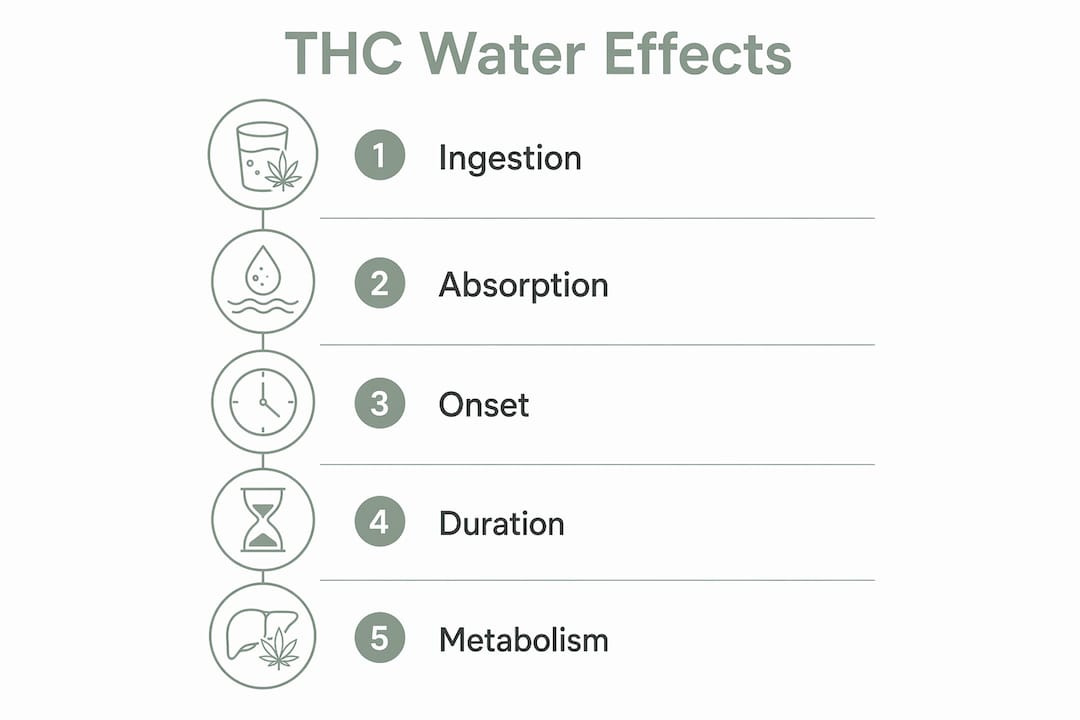
THC-infused water delivers cannabis effects through nano-emulsion technology, a process that breaks THC oil into particles smaller than 100 nanometers and suspends them evenly in water. The result is a beverage where THC doesn’t float to the top or settle at the bottom. It’s fully integrated, absorbed quickly, and far more predictable than most cannabis formats you’ve tried before.
Here’s what sets it apart from a standard cannabis product:
- Water-soluble THC: Traditional THC is oil-based and doesn’t mix with water naturally. Nano-emulsion converts it into a water-compatible form that your body’s soft tissues absorb directly.
- Faster absorption: Because the particles are so small and water-soluble, they bypass some of the slower digestive steps that delay edibles.
- Even distribution: Nano-emulsified THC particles stay under 100 nm in size, which keeps them uniformly suspended throughout the drink with no separation.
- Consistent dosing: Each sip delivers roughly the same concentration, so you’re not getting a surprise hit from a settled layer at the bottom of the bottle.
- Hydration plus THC: Many formulations add electrolytes, making THC water a functional beverage rather than just a delivery mechanism.
THC concentrations in these drinks vary widely. Some options contain low doses of THC per serving, while other products go much higher. Knowing what’s in your bottle before you drink is the first step to a good experience.
How THC water compares to edibles and alcohol

The biggest difference between THC water and traditional edibles comes down to how your body processes each one. Edibles, like gummies or baked goods, have to move through your digestive system and get metabolized by your liver before THC enters your bloodstream. That process takes time, typically 30–120 minutes before you feel anything. THC water skips much of that delay.

Alcohol works differently too. It’s absorbed through the stomach and small intestine, and its effects are generally predictable because most adults have a baseline sense of how their body responds to a beer or a cocktail. Cannabis beverages don’t come with that same familiarity yet, which is part of why understanding the format matters.
A few key comparisons worth knowing:
- Onset time: THC water typically kicks in within 10–30 minutes, much faster than most edibles which can take 30–120 minutes to produce effects.
- Hydration vs. dehydration: THC water hydrates and sometimes adds electrolytes. Alcohol is a diuretic and actively dehydrates you.
- Dosing clarity: THC water tends to come in lower doses per serving, while THC seltzers are often positioned for social settings with somewhat higher doses.
- Duration of effects: THC water effects tend to be shorter and less intense than high-dose edibles, making it easier to manage your experience.
- Social vs. daily use: THC seltzers are often marketed for gatherings and events. THC water, with its lower dose and hydration focus, fits more naturally into a daily wellness routine.
If you’re curious about how THC beverages stack up against alcohol more broadly, Tryfloral’s THC vs. alcohol comparison covers the wellness side of that conversation in more depth.
What effects you can expect and when
Most people feel the effects of THC-infused water within 10–30 minutes, according to Harvard Health research. This is noticeably faster than a gummy or brownie.
Onset speed: Water-soluble THC can begin taking effect in 10–30 minutes, compared to 1–3 hours for oil-based THC products.
The effects themselves tend to feel lighter and more manageable than high-dose edibles. Common experiences include:
- A mild, relaxed buzz rather than an intense high
- Reduced tension and a calm, sociable mood
- Gentle euphoria at moderate doses
- Easier to gauge and adjust compared to edibles
That said, individual responses vary. Your metabolism, body weight, whether you’ve eaten recently, and your personal tolerance all affect how quickly and intensely you feel anything. Someone who ate a full meal an hour ago may feel effects later than someone who drank on an empty stomach.
The contrast with traditional edibles is worth repeating. Edibles go through liver metabolism, where THC converts to 11-hydroxy-THC, a compound that tends to produce stronger and longer-lasting effects. THC water doesn’t follow that same metabolic path, which is part of why the experience feels different, not just faster.
Dosing, potency, and staying safe
THC water typically contains modest amounts of THC per serving, with seltzers often having somewhat higher doses. Those numbers sound modest, but the fast onset changes the math on how you should pace yourself.
Dr. Staci Gruber’s research highlights a real risk: if you drink one THC beverage, don’t feel effects quickly, and then have another, you can accidentally double or triple your dose in a short window. Going from a pleasant experience to an overwhelming one happens faster with beverages than with edibles, precisely because absorption is quicker.
Safe consumption looks like this:
- Start with a low dose: 2–5 mg is a reasonable starting point, especially if you’re new to THC beverages.
- Wait at least 30 minutes before considering a second serving, even if you don’t feel much yet.
- Avoid mixing with alcohol or other substances, which can amplify impairment unpredictably.
- Know your setting: THC beverages impair judgment and reaction time. Don’t drive.
- Track what you consume: Keep a simple note of dose and timing so you can learn your personal response pattern.
Pro Tip: Start with half a serving if a product contains 5 mg or more. The dose-response curve for nano-emulsified THC is steeper than most people expect, and a smaller amount often delivers a perfectly enjoyable experience without the risk of going too far.
Experts also caution that THC drinks shouldn’t be assumed safer than alcohol by default. Regulatory frameworks around cannabis beverages are still catching up, and dose transparency across brands remains inconsistent.
How to choose and use THC water responsibly
Reading the label carefully is the single most useful habit you can build. Look for the total THC content per serving, the serving size, and whether the product uses nano-emulsified or water-soluble THC. Products that list “water-soluble THC” or “nano-emulsion” are likely to deliver faster and more consistent effects than those using oil-based tinctures.
Think about what you actually want from the experience:
- Daily hydration and calm: A 2–5 mg THC water fits naturally into a morning or afternoon routine, especially if you’re looking for a mild, functional effect without the calories or hangover of alcohol.
- Social occasions: A 5–10 mg THC seltzer works better for shared moments with friends, where a slightly stronger effect is welcome.
- Sleep support: Lower-dose THC beverages taken an hour before bed can complement a wind-down routine. Tryfloral’s THC drinks sleep guide explores this use case in detail.
A few practical tips for responsible use:
- Don’t drink THC water on an empty stomach if you’re new to it. Food slows absorption and gives you more control.
- Store products in a cool place, ideally your fridge, to maintain potency and freshness.
- Never share a THC beverage with someone who hasn’t consented or doesn’t know what’s in it.
- If you’re making your own infused drinks at home, nano-emulsified water-soluble drops blend cleanly into mocktails without the oily separation you get from standard tinctures.
Claims that specific THC beverages target outcomes like better sleep or increased energy lack solid scientific backing at this point. Enjoy the experience for what it is, not what a marketing label promises.
The science behind nano-emulsion and why it changes everything
Nano-emulsion is the technology that makes THC water possible. The process uses ultrasonic waves and emulsifying agents to break THC oil into nanoparticles under 100 nanometers in size. At that scale, the particles can stay evenly suspended in water indefinitely without separating, which is something standard oil-based THC simply cannot do.
The size of the particles matters for more than just mixing. Smaller particles cross biological membranes more efficiently, including the lining of your mouth, throat, and digestive tract. This is why water-soluble THC reaches the bloodstream faster and more completely than oil-based formats.
| Consumption method | Typical onset time | Bioavailability notes |
|---|---|---|
| Nano-emulsified THC water | 10–30 minutes | High, absorbed through soft tissues directly |
| Oil-based tincture | 1–3 hours | Lower, slowed by digestion and liver processing |
| Traditional edible (gummy, brownie) | 30–120 minutes | Variable, depends on liver metabolism |
| Inhalation (smoking, vaping) | 1–5 minutes | High but bypasses digestive system entirely |
Formulation consistency is one of the harder challenges in this space. Nano-emulsions can degrade over time or with temperature changes, which affects both potency and shelf life. Brands that invest in quality control and cold-chain handling, like Tryfloral’s farm-to-fridge approach, tend to deliver more reliable results from bottle to bottle.
Pro Tip: When buying THC water, check the manufacturing date and storage instructions. A product that’s been sitting at room temperature for months may have lost some of its nano-emulsion stability, which can affect both onset speed and consistency.
How your body metabolizes THC water differently
The metabolic path THC takes through your body depends heavily on how you consumed it. With THC water, absorption begins in the soft tissues of your mouth and continues through the stomach lining, bypassing the extensive first-pass liver metabolism that edibles go through. That liver step is what converts THC into 11-hydroxy-THC, the compound responsible for the more intense, longer-lasting high that edibles are known for.
Because THC water skips or reduces that conversion, the effects feel different in character, not just in timing. You get THC’s primary effects, relaxation, mild euphoria, reduced tension, without the amplified intensity that liver metabolism adds. Bioavailability, meaning how much of the THC you consume actually reaches your bloodstream, is generally higher with nano-emulsified products than with oil-based edibles, where a significant portion gets lost in digestion.
Individual metabolism plays a real role here. People with faster metabolisms may feel effects sooner and have them fade more quickly. Body composition, hydration status, and gut health all influence how efficiently THC absorbs. This is why two people drinking the same product at the same time can have noticeably different experiences. If you want to understand how calorie-free THC drinks fit into a wellness-focused lifestyle, Tryfloral’s guide on calorie-free THC drinks covers the lifestyle angle well.
Side effects and interactions to know before you drink
THC water is not without risks, and the fast onset that makes it appealing also makes overconsumption easier to stumble into. Dr. Gruber notes that even small amounts of THC can be intolerable for some people, causing anxiety, elevated heart rate, nausea, or paranoia. Others handle larger amounts without issue. You won’t know where you land until you try, which is exactly why starting low matters.
Specific side effects associated with THC beverages include:
- Anxiety or unease, particularly at higher doses or in unfamiliar settings
- Elevated heart rate and blood pressure, which can feel alarming if unexpected
- Nausea or vomiting in cases of overconsumption
- Paranoia or agitation, more common in people sensitive to THC or those who’ve consumed too much
- Impaired coordination and judgment, relevant for any activity requiring focus or reaction time
Interactions with other substances add another layer of caution. Mixing THC with alcohol intensifies impairment in ways that are hard to predict. Certain medications, particularly those that affect the liver’s cytochrome P450 enzyme system, can interact with cannabinoids and alter how your body processes both the THC and the medication. If you take prescription medications regularly, talking to a doctor before adding THC beverages to your routine is a reasonable step.
For those newer to cannabis beverages, Tryfloral’s guide on enjoying THC drinks responsibly walks through practical strategies for avoiding overconsumption, with particular attention to the rapid onset that catches many first-timers off guard.
Try Tryfloral’s farm-to-fridge THC beverages
Tryfloral makes THC beverages the way they should be made: starting at the farm and ending in your fridge, with quality you can actually taste and trust. Every can uses nano-emulsion technology for consistent, fast-acting effects, and zero calories so you’re not trading your wellness goals for a good time. Whether you want something fruity and social or clean and refreshing, Tryfloral has a flavor for the moment.
Explore the farm-to-fridge difference and find your go-to THC seltzer at Tryfloral.
Key Takeaways
THC-infused water works through nano-emulsion technology that makes THC water-soluble, enabling absorption through soft tissues within 10–30 minutes, far faster than traditional edibles.
| Point | Details |
|---|---|
| Nano-emulsion is the core mechanism | THC particles under 100 nm stay evenly suspended in water and absorb faster than oil-based formats. |
| Onset is 10–30 minutes | Effects arrive much sooner than edibles (30–120 minutes), so waiting before a second serving is critical. |
| Dosing starts at 2–5 mg | THC water is typically lower-dose than seltzers (5–10 mg); starting low reduces overconsumption risk. |
| Metabolism differs from edibles | THC water reduces liver first-pass conversion, producing lighter effects than edibles of the same dose. |
| Side effects are real | Anxiety, elevated heart rate, and nausea are possible, especially if you consume too much too quickly. |
